The Pink Desert That Blooms for Just 48 Hours a Decade
The Atacama Desert in Chile, which goes down in history as the driest desert in the world, is usually just a brown spot on the map. Its annual rainfall is about 15 millimeters, and in some areas not a drop of water falls for years. But the strangeness of nature is that even in such a barren environment, an amazing phenomenon occurs about once every ten years. It is the "Desierto Florido" (Florido Desert), or "Blooming Desert." When unusually heavy rainfall occurs due to the El Niño climate pattern, seeds that have been dormant in the desert floor for years awaken. Within a few weeks, the desert is covered in pink, purple, yellow, and white, and each flower takes only 48 hours to fully bloom, pollinate, and fade. This brief window is a unique opportunity that attracts the attention of tourists, scientists, and photographers from all over the world.How does a desert suddenly turn pink?
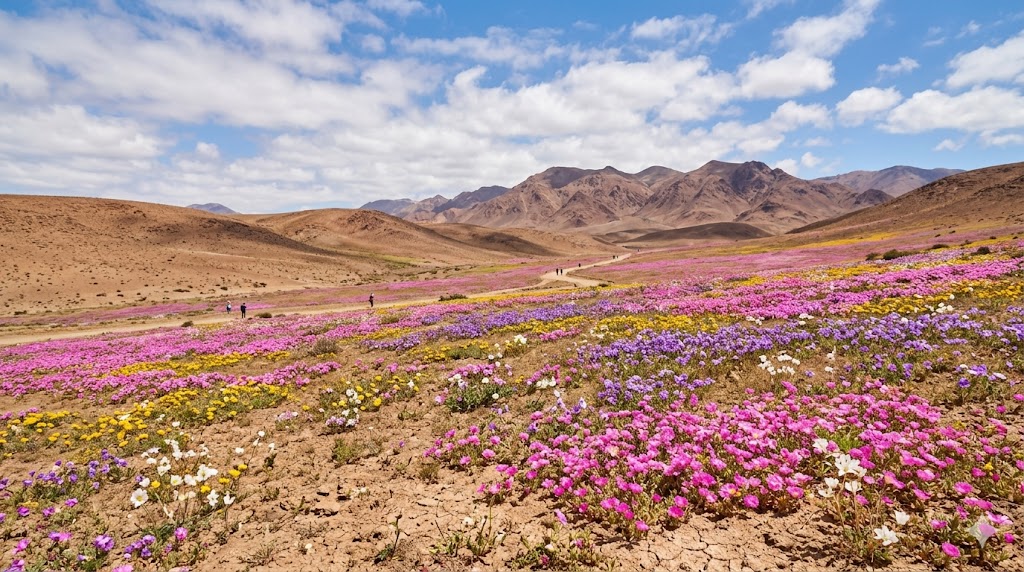
The Atacama Desert in Chile is known as the driest desert in the world. Its annual rainfall is usually less than 15 millimeters. In some areas, not a drop of water has fallen for years. It is hard to imagine such a desert suddenly turning bright pink, yellow, and purple. But it is a natural phenomenon. The phenomenon is called the "Desierto Florido" or "Blooming Desert."
This phenomenon occurs when the Atacama Desert receives unusually high rainfall due to the so called "El Niño" climate phenomenon. This usually happens only once every five to ten years. But rainfall alone is not enough for a full bloom. The rain must come at exactly the right time, in the right amount, and for a long enough period. If the rains are good, usually in July and August, the desert will begin to bloom by September.
But what is even more amazing is that these seeds lie dormant in the desert for years, sometimes decades. They are called "storm seeds." Their outer covering is a hard shell that prevents water and oxygen from entering. Therefore, they will not germinate with ordinary light rain. But when there is enough rain, the shell breaks and the growth inhibitors inside the seed dissolve. Then, in a short time, the flowers bloom.
The most famous of these flowers are the "Pata de Guanaco" and the "Ananuca" flowers, which are pink and white. There is also a purple flower called the "Aylmo." In total, more than 200 species of flowers appear in the Atacama Desert during this short period of time. Many of them are endemic to the desert, meaning they are found nowhere else in the world. During this phenomenon, the desert suddenly turns into a huge flower garden.
Tourists from all over the world flock to see this spectacle. The Chilean government promotes this phenomenon as an eco tourism venture. However, the flowering period is extremely short. Within a few weeks, the desert becomes dry and dark again. It reminds us of the power and unstable beauty of nature.
The secret of the mysterious bloom that appears only once every ten years
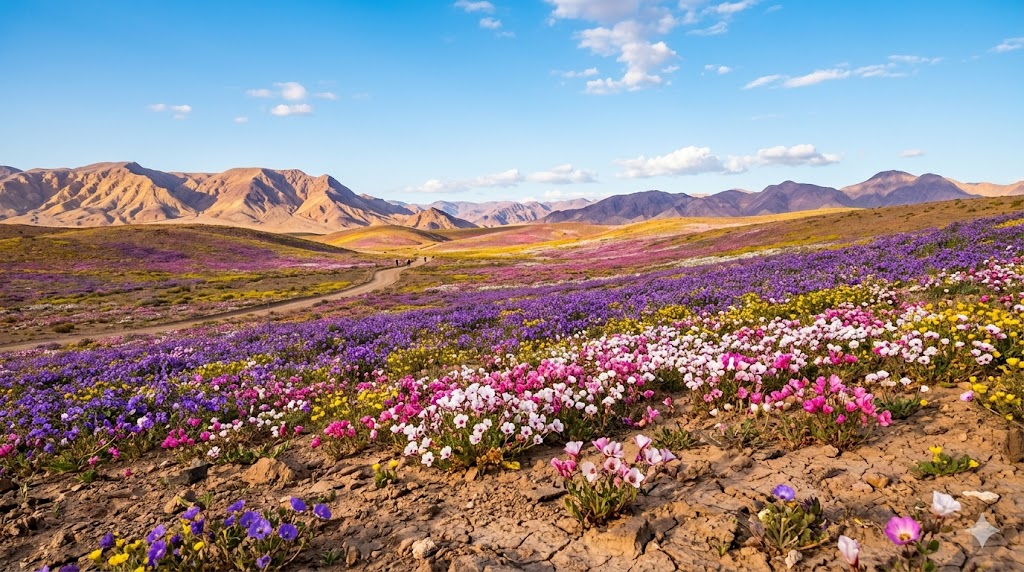
This bloom, which occurs about once every decade in the Atacama Desert of Chile, has even amazed scientists. Among its secrets are timing, the unique adaptation of the seeds, and the delicate balance of the ecosystem. This phenomenon has earned the desert the nickname "the most extreme flower garden on Earth."
The first secret is the unusual dormancy of the seeds. The seeds of many plant species that grow in the Atacama Desert can lie dormant in the ground for 10, 15, and sometimes even 20 years. They are called "seed banks." These seeds have special genetic characteristics that allow them to withstand extreme conditions such as lack of water, temperature fluctuations, and salinity. Their outer shell is covered with sodium chloride and other minerals, which protect them from moisture and microbes.
The second secret is the precision of the rain. These seeds will not germinate simply because it rains. They need a "heavy rain signal." That is, they need 10 to 15 times more rain than normal. This heavy rain breaks down the chemical barriers in the seed coat, activating the gibberellin growth hormone in the seed. Lightning strikes that accompany the rain also add nitrogen compounds to the soil, which act as a fertilizer.
The third secret is the great coordination of pollination. These flowers do not last just 48 hours. In fact, the entire flowering process can last between 2 and 3 weeks. But each flower species takes only 48 hours to fully bloom, pollinate, and fade. During this short period, they must attract bees, butterflies, beetles, and birds as pollinators. Therefore, the colors, scents, and nectar produced by the flowers are extremely intense. The scent of some flowers can be carried for miles.
The fourth secret is the transformation that occurs in the ecosystem after this event. After the flowering is over, the seeds that fall to the ground again become dormant. But the dried flowers and leaves are added to the soil as organic fertilizer, thereby enriching the soil for the next rain. Fossil evidence reveals that this cycle has been going on for thousands of years. So, although it may be called "mysterious," this is actually a very complex and intelligent survival strategy of nature.
48 hour natural wonder that attracts tourists from all over the world
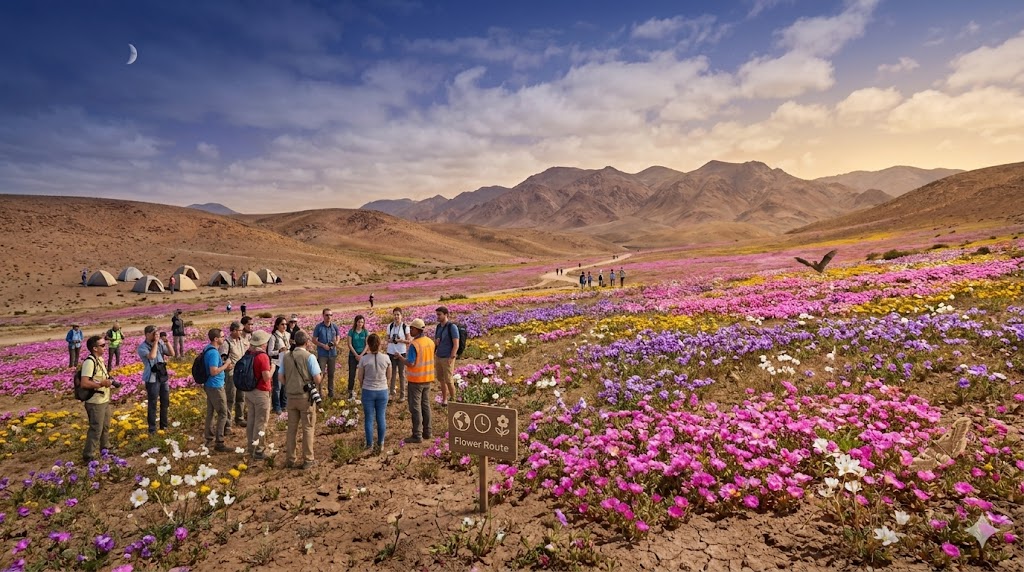
This flowering in the Atacama Desert of Chile, which occurs about once every ten years, is a rare natural phenomenon that attracts tourists from all over the world. People come from as far away as North America, Europe, Japan, and Australia to see it. This is a golden opportunity for the tourism industry.
The uniqueness of this phenomenon is its unpredictability. No one can accurately predict it in advance. It depends on factors such as the El Niño weather pattern, the temperature of the Pacific Ocean, and the melting of snow in the Andes Mountains. The Chilean National Meteorological Institute and the National Wildlife Institute closely monitor this event. They issue an official statement a few weeks before the flowering begins. As soon as the statement is received, tourists rush to book flights and accommodation.
The most popular tourist destinations are the city of Copiapo and the Valle de Huasco Valley. The density of flowers is highest in these areas. Also very popular is Pan de Azúcar National Park, where more than 150 species of pink, purple, yellow, white, and orange flowers can be seen in one place. Guided tours, hiking trails, and overnight camps in the desert are also organized for tourists.
Because the flowers bloom and fade within 48 hours, visitors have a very short window. The petals begin to open with the morning sun. By noon, they are fully open. By sunset, some flowers have already begun to fade. At night, they are pollinated by nocturnal butterflies and bats. By the next morning, most of the flowers have withered. Therefore, it is essential for visitors to be there at the right time.
This tourism industry contributes significantly to the Chilean economy. During the last major bloom, which occurred in 2015, it is estimated that more than 20,000 tourists visited the area. It generated more than $5 million in revenue for the local economy. It is also a huge opportunity for local hotels, restaurants, transportation services, and handicraft vendors. The Chilean government also creates a special tourist route called the "Flower Route" (Ruta de las Flores) during such years. Seeing it is like a dream come true for many nature lovers.
Conclusion
This short lived flowering is a testament to nature's extremely subtle and intelligent survival strategy. It reminds us of how life can survive even in extreme conditions. The fact that seeds that have been dormant for years can wake up at the right moment, complete their life cycle, and become seeds again is a remarkable evolutionary adaptation. It also highlights the importance of climate change. If even a single El Niño event can cause such a spectacular event, we can understand how much impact even a small change in weather patterns can have on ecosystems. Ultimately, this 48 hour pink desert teaches us to appreciate the beauty of impermanent things and reminds us that every moment in nature is precious.