Have you ever read a book for a few pages and then forgotten everything the next day? Or memorized material for an exam and then forgotten it a week after the exam? If so, you are not alone. Most people learn the wrong way. They try to absorb information but do not build real understanding. To solve this problem, let us introduce one of the world’s most powerful learning methods, the Feynman Technique. Popularized by Nobel Prize winning physicist Richard Feynman, this method is extremely simple: “If you cannot explain something simply, you do not understand it well enough yet.” This one sentence encapsulates the entire philosophy of true learning. In this article, we explore Feynman’s philosophy of learning, its four steps, and most importantly, how you can apply this method to your daily life. Master the art of transforming complexity into simplicity.
Richard Feynman’s Philosophy of Learning: From Simplification to Deep Understanding
Step 4 of the Feynman Technique: How to Make the Learning Process Work
The Power of Explaining Complex Ideas Simply: Applying the Feynman Technique to Everyday Life
Richard Feynman’s Philosophy of Learning: From Simplification to Deep Understanding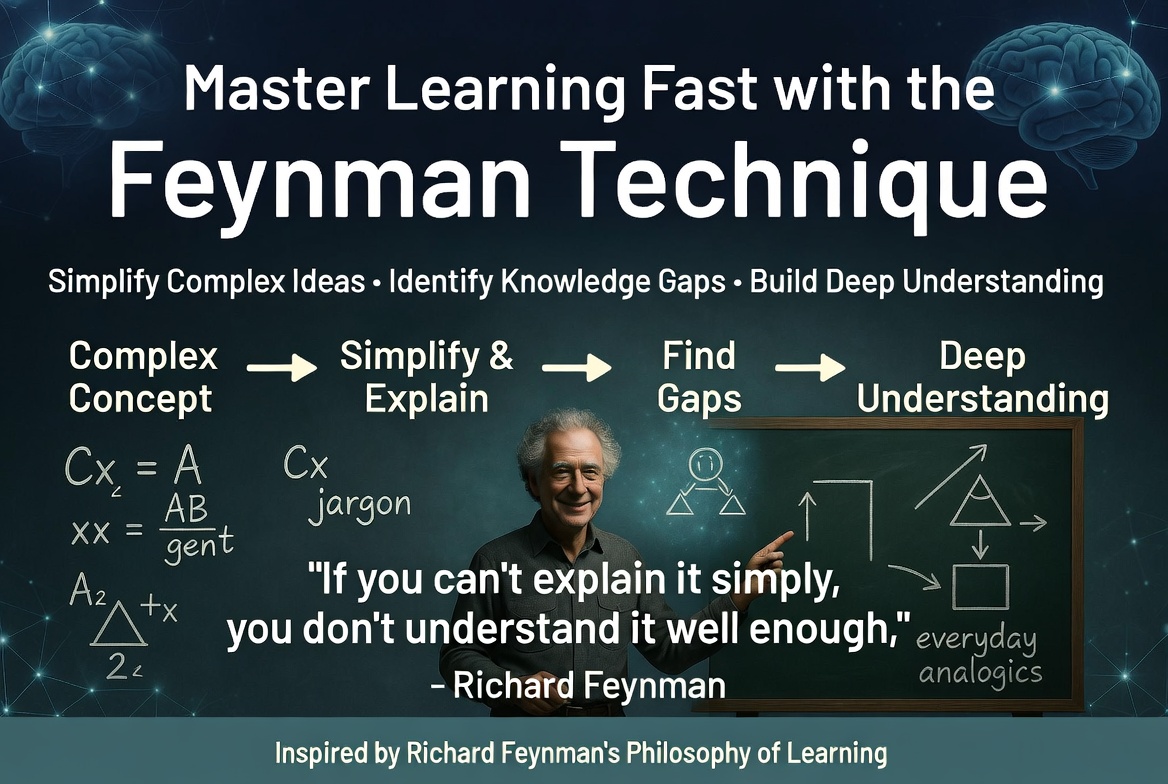
Richard Feynman was a world renowned physicist and one of the greatest teachers. The heart of his philosophy of learning is that even the most complex concepts should be explained so simply that if you cannot do that, you do not really understand them yet. For Feynman, true knowledge is not a set of memorized facts, but the ability to rephrase ideas in your own words. He believed that most people learn by rote or by memorizing formulas, and there is no real deep understanding. Therefore, according to his philosophy, any subject should be simplified so that it can be explained to a twelve year old child.
A key principle of this philosophy is identifying the gaps. When you try to explain a point, the places where you cannot explain are precisely where your knowledge is lacking. According to Feynman, we often fool ourselves into thinking we know something, but only when we try to explain it to someone else do we discover our ignorance. Simplification is not about cutting out information, but rather getting down to the most essential fundamental principles. This is why Feynman used simple metaphors and everyday examples to explain complex theories in physics.
Furthermore, inquiry plays an important role in Feynman’s philosophy of learning. He encouraged us to question, doubt, and seek the why behind everything. One of his famous quotes is “I would rather admit that I do not know than be ashamed of what I do not know.” This modesty is very powerful in learning because it motivates us to constantly discover new things. The Feynman Technique is about pointing out that, ultimately, knowledge is not a static thing, but a dynamic process. If you cannot explain something simply, it means you still have to explore.
The deeper message of this philosophy is that simplification is not a weakness, but a strength. Many people think that complex language and technical jargon are signs of intelligence. But Feynman rejected that. According to him, a true expert can present any complex idea in a way that ordinary people can understand. His “Feynman Lectures on Physics” series of books is a perfect example of this. They present even the most difficult concepts in physics with a minimum of mathematics and a maximum of understanding. Therefore, Feynman’s philosophy of learning teaches us that true knowledge is not what you have, but what you can give to others.
Step 4 of the Feynman Technique: How to Make the Learning Process Work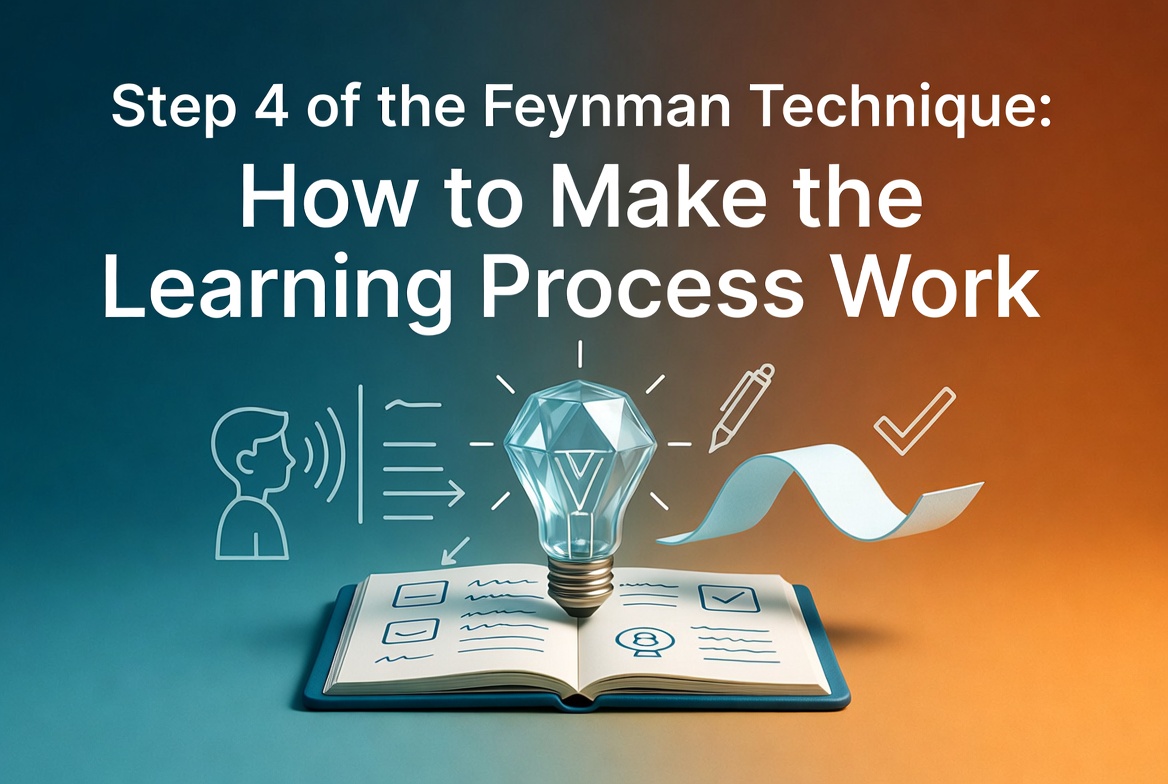
The Feynman Technique is a simple but highly effective learning method with four steps. The first step is to identify the concept you want to learn and write it down at the top of a piece of paper. For example, choose a topic like quantum mechanics or democracy. Then imagine explaining everything you know about that topic. The important thing in this step is that you start from your own memory and understanding, without looking at any textbook or notes. This will clearly show your current level of knowledge and the gaps.
The second step is to explain it in simple, child friendly language. Here you should assume that the person listening to you has no prior knowledge. That is, you should not use technical jargon, complex formulas, or abstract terms. Instead, you should use everyday examples, stories, and simple sentences. For example, instead of saying spacetime curves, you could explain gravity by saying the bed sags when you put a heavy object on it. This step is often awkward, because we are used to expressing ideas in the same language we learned. But it is precisely in this awkwardness that deep learning occurs.
The third step is to identify gaps and go back to the source material. If you get stuck somewhere in the explanation, or if the explanation is unclear, that is a good sign. It means that you still do not understand that part well. Then you go back to the textbook, video, or other source and relearn, especially the part you failed to understand. Repeat this step. Each time, your explanation becomes simpler and more precise. This is an iterative process. You will feel your understanding deepening layer by layer. Many people skip this step, but this is the essence of the Feynman Technique, filling in the gaps.
The fourth and final step is to revise for simplicity and flow. You now reread your explanation. Are there still technical terms? Are there unnecessary complexities? Does the story flow naturally? Can you make the illustrations fit better? In this step, you edit your lesson like a writer. The goal is to make your explanation short, clear, and engaging. Ultimately, you should be able to teach the concept to anyone in five to ten minutes. After completing these four steps, you will have a much deeper understanding of the subject than before. Most importantly, you are less likely to forget it because you created it in your own words.
The Power of Explaining Complex Ideas Simply: Applying the Feynman Technique to Everyday Life
The Feynman Technique is not just for schoolchildren or scientists. It is also incredibly useful in everyday life. For example, at work, you might have to explain a complex project to colleagues. We are often used to using technical language, acronyms, and internal jargon. But by using the Feynman Technique, you can simplify your idea so much that even a new employee or someone from another department can understand it. This reduces misunderstandings and increases collaboration. If you have leadership responsibilities, the ability to explain things simply directly increases the productivity of your team.
This technique is also invaluable at home. Parents can use it to help their children with schoolwork or to explain complex family decisions such as financial planning, medical care, or legal matters. For example, take a concept like mortgage interest rate. A banker might explain it using complex mathematics, but a person who follows the Feynman Technique will explain it as a payment on top of the money you borrow. This makes it easier for a child or another family member to understand. Similarly, a doctor’s advice is often complex. If you want to understand a disease better, you can ask your doctor questions in the Feynman way to get clear answers.
Furthermore, this technique is extremely powerful in personal development. Most of us read books, but after a month we forget a lot of information. This is because we read without engagement. Using the Feynman Technique, after you have read a chapter of a book, write down the ideas in your own words on a piece of paper. Reread the parts that you cannot explain. This will increase your memory retention by seventy to eighty percent. Also, if you are learning a new skill such as coding, cooking, or yoga, try to explain the basic principles of that skill in two or three simple sentences. It will make you feel like a genius.
Ultimately, the Feynman Technique changes the way we think. When we learn to simplify complex ideas, the world around us begins to become clearer. Political propaganda, fake news, and marketing tactics are often hidden in complex language. If you can reconstruct them simply, you can easily identify their inconsistencies. The Feynman Technique is therefore not only an intellectual tool, but also a method for critical thinking. Feynman teaches us that simplicity is not naivety, but the highest form of genius. In everyday life, try to look at every complex idea you encounter, whether it is an economic report, a new technology, or a child’s question, through Feynman’s eyes. Then you will see how simple and beautiful the world is.
Conclusion
The Feynman Technique is not just another learning technique. It is a revolution in thinking. Feynman reminds us that the ability to simplify the complex is the pinnacle of intelligence. By following this method, you will transform yourself from a rote learner into a truly knowledgeable person. The gaps in your knowledge will be revealed, and you will be shown how to fill them. Whether at work, in the family, or when studying alone, this method will always give you an advantage. Start today. Choose one concept that you find difficult to understand and try to explain it to a twelve year old. Stop and relearn where you get stuck. Your explanation will become sharper each time. Remember that simplicity is not the end, but the beginning. Think like Feynman, and you will gain an insight you will never forget.