Why Younger Generations Are Turning Away From Marriage
Marriage rates have declined significantly around the world in recent decades, and the average age of marriage has also increased. Once considered an “essential step in adulthood,” marriage has become an optional extra in the eyes of many young people today. There are several reasons for this trend, and they are intricately intertwined. First, rising housing prices, job instability, and the enormous cost of raising children make young people see marriage as an unaffordable financial burden. Second, today’s young people value personal freedom, self-growth, and emotional peace more than previous generations and believe that marriage limits those values. Third, high divorce rates, stories of toxic relationships exposed through social media, and legal risks associated with marriage have created fear and distrust in young minds. In this article, we will delve deeper into all three factors and explain the real root causes of the younger generation’s estrangement from marriage.
Financial Pressure and the Rising Cost of Modern Life

In the past few decades, the cost of living, housing prices, and higher education have skyrocketed in almost every country in the world. But the average income of young people has not increased much, and the job market has also become more volatile in many countries. In this economic context, marriage has become a huge financial responsibility. Hosting a wedding, buying a house, and having children all require huge savings. Many young people, recognizing that they are not ready to bear this financial burden, postpone or avoid marriage altogether.
A stable home is a major requirement after marriage in any society. But in many cities today, housing prices or rent prices swallow up a large part of the monthly income of young people. For example, in cities like Colombo, Mumbai, Bangkok, or London, it is challenging for a middle class young person to even rent a house on their own. Even if they live as a couple, the debt payments, utility bills, and maintenance costs add up to a large sum. In addition, with interest rates on housing loans rising in many countries, young people are reluctant to take on the burden of paying off debt over 20 to 30 years.
Compared to previous generations, many young people today have fewer permanent jobs. With the spread of the “gig economy,” temporary, contract based, or project based jobs have become more common. These jobs do not provide a stable monthly income, pension plans, or health insurance. Young people consider it extremely risky to get married and start a family in such a situation. If they suddenly lose their jobs, they fear the debt payments, rent, and expenses for children that a married couple would have to pay.
In many cultural traditions, a wedding is an event that involves a large gathering of guests, elaborate food, clothing, jewelry, and music or entertainment. In countries like Sri Lanka, the cost of the wedding procession, the wedding hall, and the perahera can run into lakhs or crores. If this amount has to be borrowed, the first few years after marriage become a struggle to pay off the debt. Although the younger generation is questioning these traditional marriage patterns and is leaning towards simple or registered marriages, they often face huge expenses due to family and societal expectations.
Having children is often seen as one of the goals of marriage. But raising a child today is much more expensive than it used to be. The costs of nutrition, health, education such as school fees, books, and classes, entertainment, and later higher education are enormous. This is why many young couples are tempted to choose a “child free marriage.” Otherwise, they will have to significantly reduce the quality of their lifestyle.
Changing Views on Freedom, Relationships, and Happiness
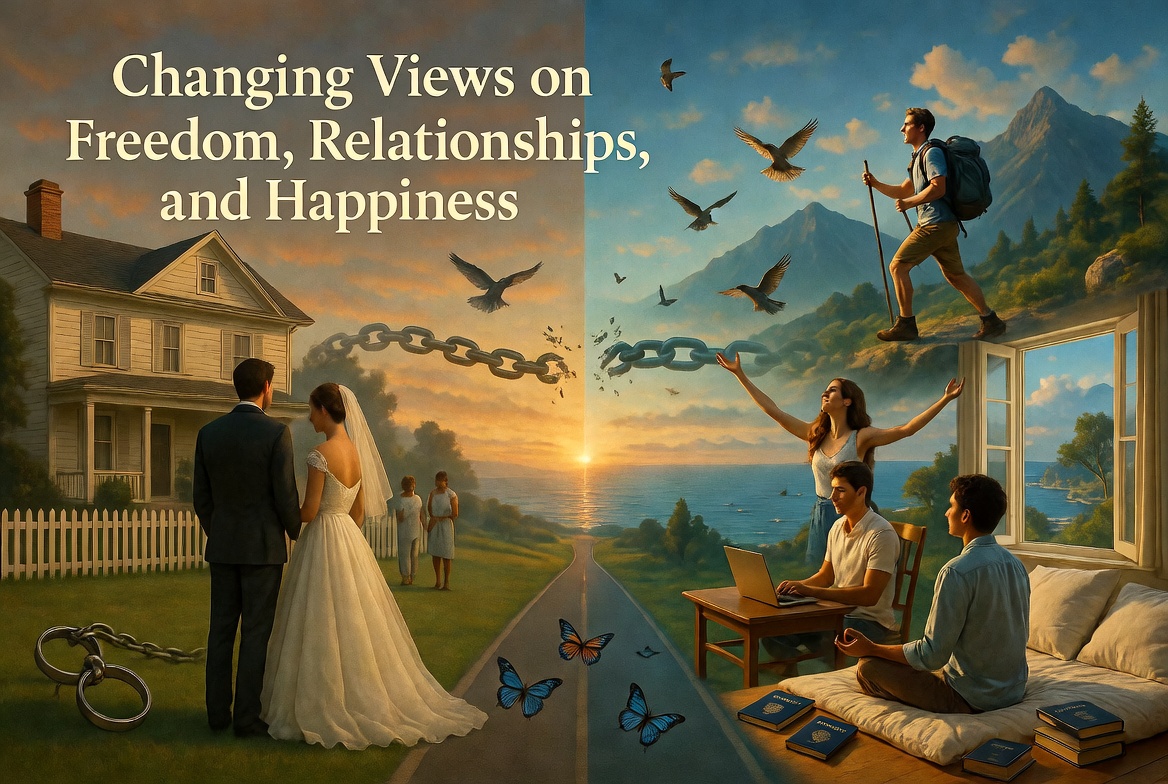
In previous generations, marriage was a sign of acceptance, security, and adulthood. It was often a decision based on family background, religious beliefs, or social pressure. But today’s younger generation values personal freedom, self growth, and emotional peace. For them, marriage is not a mandatory goal, and they are willing to reject it if it conflicts with their personal goals and happiness.
Young people today want to make every decision in their lives on their own. Marriage is a commitment that involves adjusting their life to the needs, habits, and expectations of another person. A young person living alone can spend their income as they wish, can spend their time after work as they wish, and does not need anyone’s permission if they want to change countries or cities. This freedom is largely limited in marriage. Young people who love freedom see these restrictions as a burden. For women in particular, traditional marriages often impose restrictions on travel, career decisions, and social life. Therefore, they prefer to maintain their independence without marriage.
Today’s younger generation spends more time building their identity. They prioritize developing themselves in areas such as higher education, traveling abroad, vocational training, entrepreneurship, or artistic endeavors. They often see marriage as an obstacle to this journey. For example, when a job opportunity arises abroad, a married person may have to turn it down because of their partner’s job, family obligations, or children’s education. A single person does not have such restrictions. Therefore, many young people focus on their professional and personal development throughout their 20s and 30s, ignoring marriage. They see marriage as a project that can be postponed “for later.”
The younger generation is among the first to openly understand and discuss mental health. They know that toxic relationships, constant arguments, jealousy, and emotional stress can destroy their quality of life. Marriage is an intimate relationship, and conflict can often occur. In single life, they have the opportunity to have as much solitude as they want, the peace of their own room, and control over their own schedule. Introverted or sensitive people, in particular, find the constant social interaction and need for agreement that marriage requires very tiring. They avoid marriage to preserve their peace of mind.
Young people believe that marriage is not the only path in life. They explore alternative relationship models such as “live in relationships,” “open relationships,” or “long term committed non marital partnerships.” In these models, legal and social obligations are reduced, and personal freedom is high. If a couple who live together wants to separate, they do not need to file for divorce. This seems to many young people to be a more relaxed and authentic option. In some countries, such as Scandinavian countries, live in relationships are as socially acceptable as marriage. This cultural influence is spreading to other countries through globalization.
Older generations defined happiness as “getting married, buying a house, having two children, and working at the same job until retirement.” But today’s young people define happiness as traveling, having new experiences, pursuing their passions, or simply “living a peaceful life with minimal responsibilities.” Since marriage often conflicts with these definitions, young people choose to define their own happiness instead of centering their lives around marriage.
Fear of Divorce and Loss of Trust in Traditional Marriage

Although marriage was supposed to be a “lifetime” agreement, divorce rates have increased around the world today. In many countries, about half of all marriages end in divorce. These statistics have created a great deal of distrust and fear among the younger generation. They see how marriages that started out as love later turn into bitter divorce battles, property division, child custody disputes, and emotional pain. In addition, the constant stories of failed marriages, infidelity, and toxic relationships on social media have created a frightening image of marriage in the minds of young people.
While divorce was considered shameful in previous generations, today it is a common occurrence. Young people have witnessed the divorce process of their parents or relatives. They have seen the long legal process, the indirect costs, and, most importantly, the psychological impact on children when a marriage fails. These experiences create in young people the feeling that “marriage is a risky bet.” They fear that they will also embark on the same miserable journey. Psychologically, people tend to base future decisions on negative examples from the past. Therefore, if there are many failed marriages in their circle, young people begin to believe that their own marriage will also fail.
Marriage is based on love. But with the increase in the number of divorces, there has been growing distrust of love itself. In many divorce stories, couples seem to have once loved each other deeply. But within a few years, that love has disappeared or turned into hatred. Young people are asking, “If love is so unstable, does it make sense to build a lifelong bond on it?” Social media and movies idealize romantic relationships, but in reality, young people are already seeing domestic violence, deception, neglect, and economic exploitation. This discrepancy creates confusion and distrust within them.
In previous generations, even in unhappy or abusive marriages, people stayed together “because of the kids” or “because of what society would say.” But today’s younger generation has been educated about mental health and self esteem. They recognize that constant criticism, control, manipulation, gaslighting, and emotional neglect are signs of a toxic relationship. They would rather be alone than enter into such a relationship. Furthermore, couples try to get to know each other’s true nature by living together or dating for a long time before marriage. They believe that if there are any red flags, it is wiser to leave before becoming legally bound.
Social media platforms such as Facebook, Instagram, TikTok, and Reddit strongly shape young people’s perceptions of relationships. On the one hand, they see “highlight reels” of seemingly perfect marriages with trips, loving photos, and expensive gifts. On the other hand, they are constantly confronted with divorce stories, cheating revelations, “toxic mother in law” stories, and “red flag” lists. On platforms like Reddit, there are thousands of first hand accounts of broken marriages in sections such as “r/relationship_advice” or “r/divorce.” This creates a mental pattern in young people called the “availability heuristic.” In other words, they perceive marriage itself as risky because of the easily remembered examples of broken marriages. Social media also increases the feeling that “the grass is always greener.” Even a small inconvenience in one’s marriage can seem significant when compared to the freedom of single life.
There are legal risks not only in divorce but also during marriage. In many countries, property and debts are shared after marriage. If a partner cheats or behaves irresponsibly, the other party can be financially devastated. Young people fear having to spend part of their income paying off their partner’s debts or losing half their savings in a divorce. Some couples prepare a “prenuptial agreement” to avoid these legal risks, but it is not always seen as a symbol of love and trust. Others choose to avoid marriage altogether and simply remain single.
Conclusion
It is important to understand that the younger generation’s estrangement from marriage is not the “death of marriage” but a sign of its evolution. Economic pressures, changing values, and loss of trust have led to marriage no longer being a “must do” but an “option for those who choose it.” This can be seen as a positive development because people today marry out of genuine desire rather than social pressure. However, if marriage, a long standing social institution, is to be preserved, it must adapt to new realities in a more flexible, more egalitarian, and less financially burdensome way. Ultimately, it should be remembered that young people who reject marriage are not seeking loneliness but are instead exploring a meaningful life.
Reference
· Deloitte. (2026). 2026 Gen Z and Millennial Survey.
· Lake, S. (2025, September 24). Housing costs are so high some Americans are delaying milestones like getting married, having kids and even adopting a pet. Fortune.
· Inquirer.net. (2025, July 2). Fewer weddings, more live-ins: Filipino families are changing and the numbers prove it.
· Pew Research Center. (2023). Social Trends - Marriage & Divorce.
· Kaushik, P., Pande, H., & Menon, A. U. (2024). Decoding Love Relationships During Pandemic and Post-Pandemic Phase: Understanding Gen-Zs’ Views on Romantic Relationship Management. Journal of the Indian Academy of Applied Psychology, Special Issue, 266-280.
· Bilyonaryo. (2026, February 12). SWS survey: Filipinos report lowest love-life happiness since 2004.
· Psikologi Prima Journal. (2025, May). Impact of "Marriage is Scary" Trend on Gen Z's Anxiety About Marriage. Vol. 8(1), pp. 188-189.
· Yangcheng Evening News / China Youth Daily. (2025, July 31). Last year, over 1.6 million 'post-00s' registered for marriage across the country.
· Inquirer.net. (2025, July 2). Fewer weddings, more live-ins: Filipino families are changing...