In the ancient cave complex of Ellora Caves in the Indian state of Maharashtra, the Kailasa Temple rises with its tall spires as a living testament to the boundless creativity of the human hand. Unlike other temples built by simply adding blocks of brick and stone, this is a unique creation carved vertically out of a single rock. Using the reverse engineering method of cutting from top to bottom, ancient craftsmen transformed a mountain into a temple. The project, which began in the 8th century under the patronage of Krishna I of the Rashtrakuta dynasty, took 7,000 craftsmen 50 years to complete. Measuring 100 meters long, 50 meters wide, and 30 meters high, this gigantic monument is hard to imagine as being carved entirely with hand tools, chisels, and axes. The stories from the Ramayana, Mahabharata, and Shiva Puranas depicted on its walls represent the pinnacle of ancient carving technology. With Shiva on one side, Vishnu on the other, and Jain Tirthankaras elsewhere, this temple is also a symbol of multireligious coexistence.
Mysterious Artifacts Carved from a Single Rock
Mysteries of Kailash Temple and Its Rise to a World Wonder
Mysterious Artifacts Carved from a Single Rock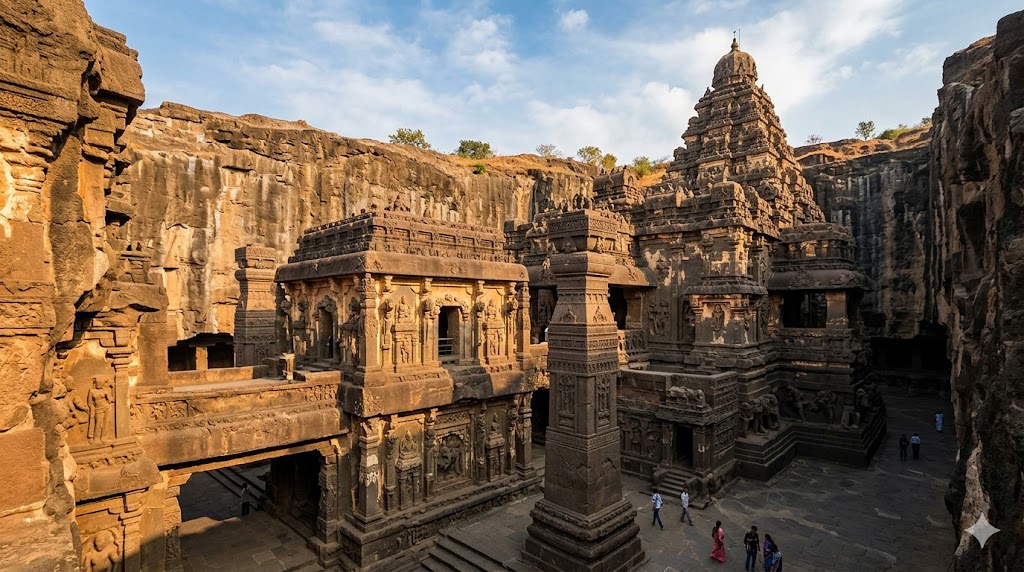
Archaeologists have identified the Kailasa Temple (circa 756–773 AD) in the Ellora Caves complex as the largest monolithic structure in world history. The temple was built not by adding bricks or blocks of stone, but by completely cutting away a single mountain peak. This method, known as “reverse construction,” involves construction starting from the top down and is a very rare architectural practice. The monument is approximately 100 meters long, 50 meters wide, and 30 meters high, and geological calculations indicate that over 200,000 tons of rock were removed to create it.
Ancient engineers first drilled holes vertically and horizontally into the rock, inserted wooden wedges into them, and poured water into the holes to split the rock. This method was widely used at the time. Craftsmen then created delicate carvings using tools such as iron chisels, carving axes, and copper and bronze hammers. Copper Age tools found in the Ellora Caves are on display in archaeological museums. What is special is that not only large blocks of stone but also small pieces of stone were used in the walls during construction, and the amount of wasted stone is reported to be extremely minimal.
Researchers identify the Kailasa Temple as a combination of three architectural styles. It has Dravidian style gopurams (gate towers), Nagara style shikharas (main towers), and Vesara style mandapams. The temple consists of five main parts: the main spire, the Nandi Mandapa (the hall housing the bull Nandi, Shiva's vehicle), the Sabha Mandapa (the open hall), three side shrines, and a two tiered interment. All these parts are carved from a single rock. According to the Archaeological Survey of India, the temple has over 100 stone pillars, each with a different design.
Among the carvings found on the temple walls, plaques depicting scenes from the Ramayana and the Mahabharata have attracted special attention from scholars. One wall depicts Ravana shaking Shiva's Mount Kailash, while another depicts Gajendra Moksha (Vishnu freeing the elephant king). Architectural historians point out that all these carvings were designed to be clearly visible in natural light. It is also notable that the orientation of the temple was designed so that sunlight reaches the main shrine on specific days. In addition, a complex drainage system for rainwater can be found here, and it is still functional today. Engineers admit that such a complex construction method would be very difficult to replicate today without modern machinery.
History of the Rashtrakuta Dynasty and the Kailash TempleHistory of the Rashtrakuta Dynasty and the Kailash Temple
The Kailasa Temple is considered the greatest architectural achievement of the Rashtrakuta dynasty, which ruled southern and central India from the 6th to the 10th centuries CE. According to most historians, the temple was built by Krishna I (756–773 CE). Inscriptions from the period confirm that King Krishna initially followed Jainism but later converted to Shaivism. As stated in the Barasi inscription at Ellora Caves, the king dedicated the temple to Lord Shiva, and it is considered a representation of the religious concept of Shiva residing on Mount Kailash in the Himalayas on the earthly plane.
Although there is no direct evidence that a large sum of money was allocated from the state treasury for this purpose, economic historians speculate that a significant percentage of the annual income of the time was spent on religious construction. There is evidence that Krishna I’s successors, Govinda III, Indra I, and Amoghavarsha II, also made decorative additions to the temple. In particular, the Ashta Dikpalakas (guardian deities of the eight directions) carved during the reign of Amoghavarsha II are more intricately crafted. Art historians have pointed out that a comparison of these images between Ellora Caves 15 and 16 shows an increase in craftsmanship over time.
Although the Rashtrakuta inscriptions do not mention exact figures, most estimates suggest that about 7,000 craftsmen were involved in the construction of this temple. The construction process can be divided into three main phases. The first was the planning phase, during which the site was surveyed and the cutting templates were prepared. The second was the rough cutting phase, during which large quantities of stone were removed from the top of the hill. The third was the fine carving phase, during which the sculptures, plaques, and details were completed. Archaeologists estimate that the entire project took about 50 years. This time frame is confirmed by comparing the carving styles of the different phases at the site.
Although the Kailasa Temple is an important center of Shaivism, its walls also contain images of Vishnu and Jain Tirthankaras. Historians consider this to be evidence of the Rashtrakuta dynasty’s polytheistic policy. Literary sources mention that the annual Mahashivaratri festival was held here. Inscriptions attest that the temple was gifted with gold ornaments and valuable offerings during the Rashtrakuta period. In 1983, UNESCO designated the Ellora Caves as a World Heritage Site, with the Kailasa Temple as its centrepiece. The designation certificate describes it as a “great example of human creativity.” Although the Rashtrakuta dynasty fell in 973 AD, the Kailash Temple they bequeathed to the world remains a monument of study and pilgrimage.
Mysteries of Kailash Temple and Its Rise to a World Wonder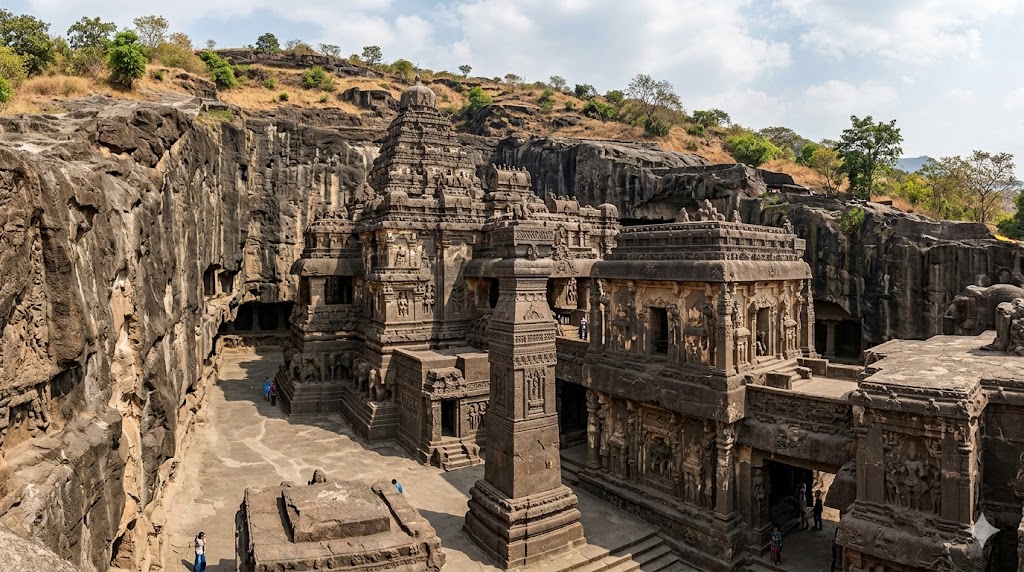
In addition to its physical marvels, the Kailasa Temple hides many mysteries that are still debated among archaeologists and historians today. The main mystery is the calculation of the labor and time required to remove such a large amount of rock, over 200,000 tons. According to modern engineering calculations, this work should have taken at least 100 years if only hand hammers and chisels were used. However, historical evidence suggests that it was completed within 50 years. No reasonable scientific explanation has yet been put forward to explain this discrepancy. One theory is that several teams of craftsmen may have worked on different parts simultaneously, but mathematical models show that this does not significantly reduce the total time.
Although there are many legends surrounding this temple, there are no historical sources to confirm them. For example, the story that the temple was built by demons is merely folklore and has no archaeological evidence. Similarly, the story that the king prayed to the gods to build the temple in a single night is also considered a later literary creation. During excavations conducted by the Archaeological Survey of India, no evidence has been found to support any supernatural explanation. Instead, all evidence points to this being the result of the skill of human craftsmen, as well as an enormous investment of time and effort.
It has been observed that sound reflection is high in certain areas of the temple. If a sound is made in the central pavilion, it reverberates for a longer period than usual. Some researchers speculate that this was designed to create an atmosphere conducive to meditation. However, it is uncertain whether this was a deliberate design feature or merely a coincidence. In addition, while geological records indicate that some of the stones contain iron ore, there is no evidence that they were designed to create a magnetic field. Such claims are merely speculations that have not been scientifically tested.
The Kailasa Temple became world famous through the accounts of British archaeologists in the 19th century. Archaeologists such as James Burgess described it as one of the most magnificent monuments in India. In the late 19th and early 20th centuries, the Royal Asiatic Society and the Bombay Archaeological Society published detailed accounts of the temple. In the mid 20th century, mapping conducted by the Archaeological Survey of India described the extent and complexity of the carvings. In 1983, UNESCO inscribed the Ellora Caves on its World Heritage List, and since then, the Kailash Temple has become a center of international tourism and research. Although many questions about the temple remain unanswered, the available evidence indicates that it is a magnificent example of ancient human craftsmanship and engineering.
Conclusion
The Kailasa Temple is not just an archaeological ruin; it is a living monument to human ambition, devotion, and engineering. Many mysteries are hidden within these rocks that science still cannot solve. How were 200,000 tons of rock removed with hand tools? How were the multistory stone pillars built without glue? These unanswered questions only add to the temple’s awe. Inscribed on the UNESCO World Heritage List in 1983, it is today a major attraction that draws tourists and researchers from all over the world. Ultimately, the Kailash Temple reminds us that true wonders are not built by machinery, but by boundless dedication, vision, and manual skill. Despite the passage of ages, the silent lesson this stone temple teaches is that humanity’s greatest masterpieces will never be destroyed.