Why Some Countries Grow Rich While Others Stay Poor Today?
It is one of the most interesting questions in economics. When we look around the world, the difference in living standards can be enormous. A person living in one country may have access to good education, healthcare, technology, transportation and well paying jobs. Meanwhile someone living in another country may work just as hard but still struggle to afford basic needs.
At first, this may seem unfair or difficult to explain. However, there is no single reason why some countries become wealthy while others remain poor. Wealth develops over many years through a combination of history, education, institutions, technology, investment, geography, trade, political stability and opportunities.
In my personal view, one of the biggest mistakes people make is thinking that a country is rich simply because it has valuable natural resources. Natural resources can certainly help but they are not enough by themselves. The way a country manages its resources and develops its people can be much more important.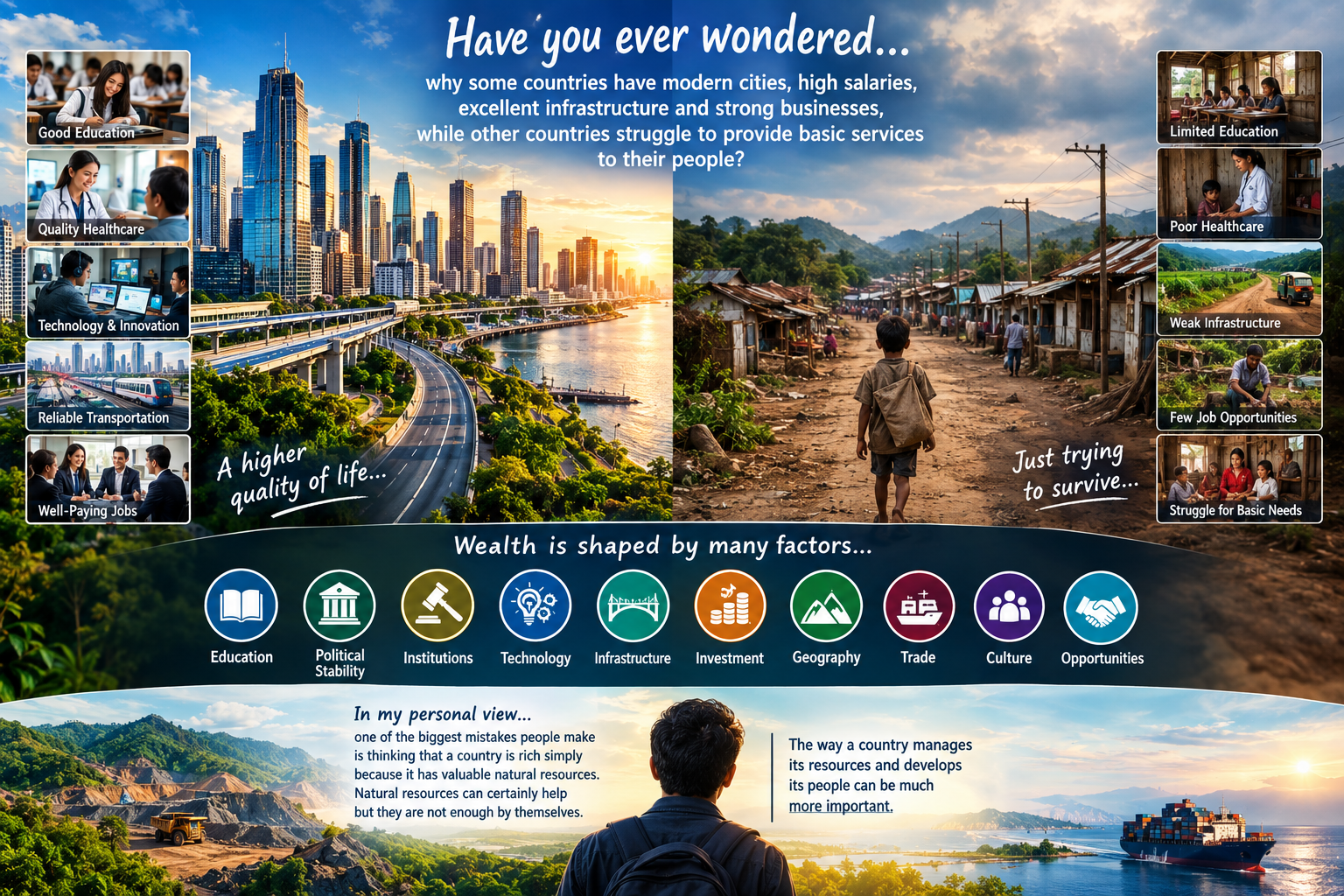
Education Creates Human Wealth
One of the strongest foundations of a wealthy country is education.
Education does more than help people pass exams. It teaches people how to solve problems, communicate, use technology, manage businesses and create new ideas.
Countries that invest heavily in education can develop a skilled workforce. Engineers can build better infrastructure. Doctors can improve healthcare. Accountants and financial professionals can help businesses manage money. Scientists can develop new technologies. Entrepreneurs can create companies and jobs.
This creates a cycle.
Better education can create better workers. Better workers can increase productivity. Higher productivity can increase business profits and wages. Higher incomes can generate more taxes, which can be invested back into education and infrastructure.
However, education alone is not enough. A highly educated population still needs opportunities to use its skills.
Personally, I believe this is particularly important for developing countries. A student can spend years studying, but if there are not enough quality jobs available, that education may not produce the economic benefits the country needs.
Strong Institutions Matter
Another major difference between wealthy and poor countries is the strength of their institutions.
Institutions include governments, courts, banks, regulators, public agencies and other systems that help a country function.
Imagine starting a business in a country where contracts are respected, courts function properly, property rights are protected, and government regulations are relatively predictable.
You may feel more comfortable investing your money.
Now imagine trying to start the same business in a country where regulations suddenly change, contracts are difficult to enforce, corruption is common or political instability creates uncertainty.
You may think twice before investing. This is why institutions matter so much.
Businesses need confidence before making long term investments. People need confidence that their property and savings will be protected. Investors need confidence that the rules will not suddenly change.
In my opinion, trust is an invisible form of economic infrastructure. You cannot see it like a highway or a port but it can have a major effect on economic activity.
Technology Changes Everything
Technology has completely changed the way countries create wealth.
A country does not necessarily need huge amounts of natural resources to become wealthy. Technology allows countries to produce more with fewer resources.
Think about countries that became major technology and manufacturing centers. Their success was not simply based on having large amounts of oil, gold or other natural resources.
Instead, they developed knowledge, industries, infrastructure, skilled workers and technology.
Technology also allows developing countries to move faster.
A small business can now sell products internationally through the internet. A farmer can use modern technology to improve productivity. A student can access educational material from universities around the world.
This creates opportunities that previous generations did not have.
However, technology also creates a challenge. Countries that fail to adopt new technologies can fall further behind.
Infrastructure Is the Backbone of an Economy
Imagine a country with talented workers and good businesses but terrible roads, unreliable electricity, slow internet, inefficient ports and poor transportation.
Businesses will have difficulty operating efficiently. While Infrastructure connects people and businesses.
Roads allow products to move from factories to markets. Ports allow countries to participate in international trade. Electricity allows factories and businesses to operate. Internet infrastructure allows companies to communicate with customers around the world.
This is why infrastructure investment can have a long term economic impact.
When infrastructure improves, transportation costs can fall and businesses can become more productive.
From my perspective, infrastructure is one of those things people often take for granted when it works properly. We notice a road when it is damaged, but we may not realize how important the entire transportation network is to the economy.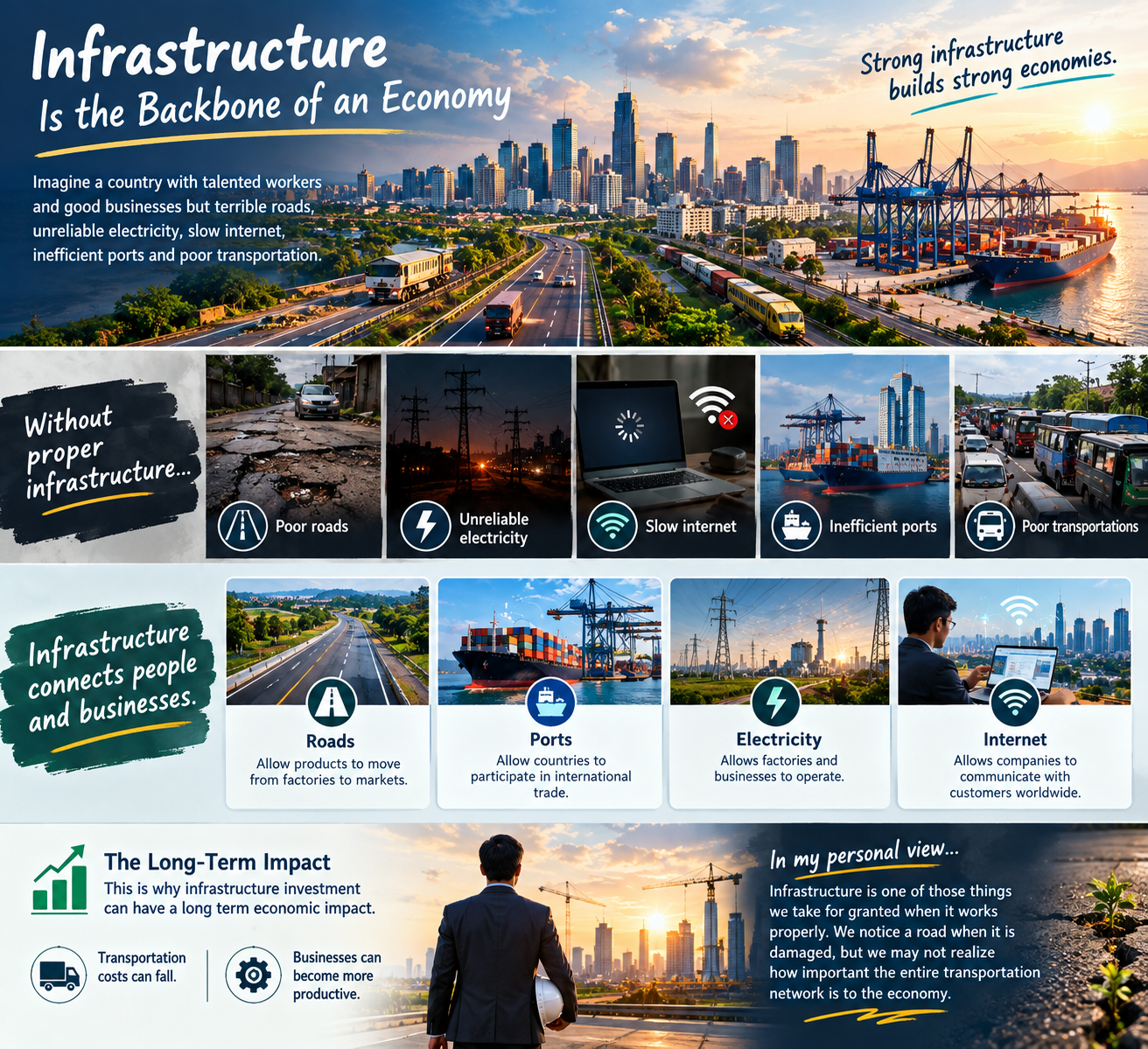
Geography Can Help or Create Challenges
Geography also plays a role in economic development.
Countries with access to major oceans, navigable rivers or important trade routes may have advantages in international trade.
Landlocked countries can face additional transportation challenges because their goods need to pass through neighboring countries before reaching international markets.
Climate can also influence agriculture, health, infrastructure and productivity. But geography should not be treated as destiny.
There are countries that have overcome geographical disadvantages through technology, infrastructure, trade agreements and good economic policies.
Therefore, geography can create advantages or disadvantages but human decisions still matter.
History Leaves a Long Shadow
A country's current economic situation is often connected to its history.
Colonialism, wars, political instability, slavery, economic crises and past government policies can influence institutions and economic structures for generations.
Some countries inherited infrastructure and institutions that supported industrial development. Others were left with economic systems designed mainly to extract resources rather than develop broad domestic industries.
Historical events can therefore create advantages or disadvantages that remain visible today.
However, history should not be used as an excuse to assume that a country's future is permanently determined.
Countries can change.
South Korea, Singapore and several other economies experienced major transformations within relatively short historical periods. Their experiences demonstrate that economic development can accelerate when education, investment, technology, infrastructure, trade and institutions develop together.
My Personal Perspective
When I think about why some countries are rich and others remain poor, I do not think the answer is simply that people in rich countries work harder.
People everywhere work hard.
A farmer in a developing country can work from early morning until evening. A factory worker can work long hours. A small business owner can spend years trying to build a company.
The difference is often the environment surrounding those people.
If a hardworking person has access to good education, reliable electricity, transportation, financial services, technology, stable laws and a large market, their effort may produce much greater economic results.
This is why I believe countries should focus not only on telling people to work harder, but also on creating an environment where hard work can actually turn into opportunity.
At the same time, individuals also have an important role. Learning new skills, adapting to technology, starting businesses, saving, investing in education and becoming more productive can contribute to economic development.
The difference between rich and poor countries is much more complicated than natural resources or geography.
Education develops human capital. Technology increases productivity. Infrastructure connects economies. Strong institutions create confidence. Political stability encourages investment. Trade connects countries to global markets. History shapes today's opportunities, while good policies can influence tomorrow's possibilities.
Perhaps the most important lesson is that countries are not simply born rich or poor.
Economic development is a process.
And behind every successful economy are millions of people, businesses, workers, students, entrepreneurs, engineers, farmers, teachers, and innovators contributing to that process.