Why a Country’s Currency Becomes Weak? Causes and Consequences
Introduction
The value of a country’s currency is closely connected to the strength of its economy. When a currency becomes weaker against currencies such as the US dollar, euro or British pound, people often notice it through higher prices and increased living costs. Currency weakness is not caused by one single problem. It usually happens because several economic, political and international factors come together. Sometimes a currency falls gradually over many years. In other situations, it can lose significant value within a short period because of a financial crisis, political uncertainty or a sudden shortage of foreign currency. A weak currency does not automatically mean that a country is poor or that its economy is completely failing. Some countries deliberately maintain relatively weak currencies to support exports. However, a rapidly falling currency can create serious problems when the country depends heavily on imported goods.What Does a Weak Currency Mean?
A currency becomes weak when its value falls compared with another currency.
- For example, imagine that US$1 is equal to 300 units of a country's currency. Later, US$1 becomes equal to 350 units. The local currency has weakened because more local currency is now required to purchase one US dollar.
This matters because countries do not produce everything they need themselves. They import fuel, machinery, vehicles, medicines, computers, food ingredients, raw materials and many other products. If the local currency becomes weaker, importers need more local money to purchase the same amount of foreign goods. This can eventually affect ordinary consumers.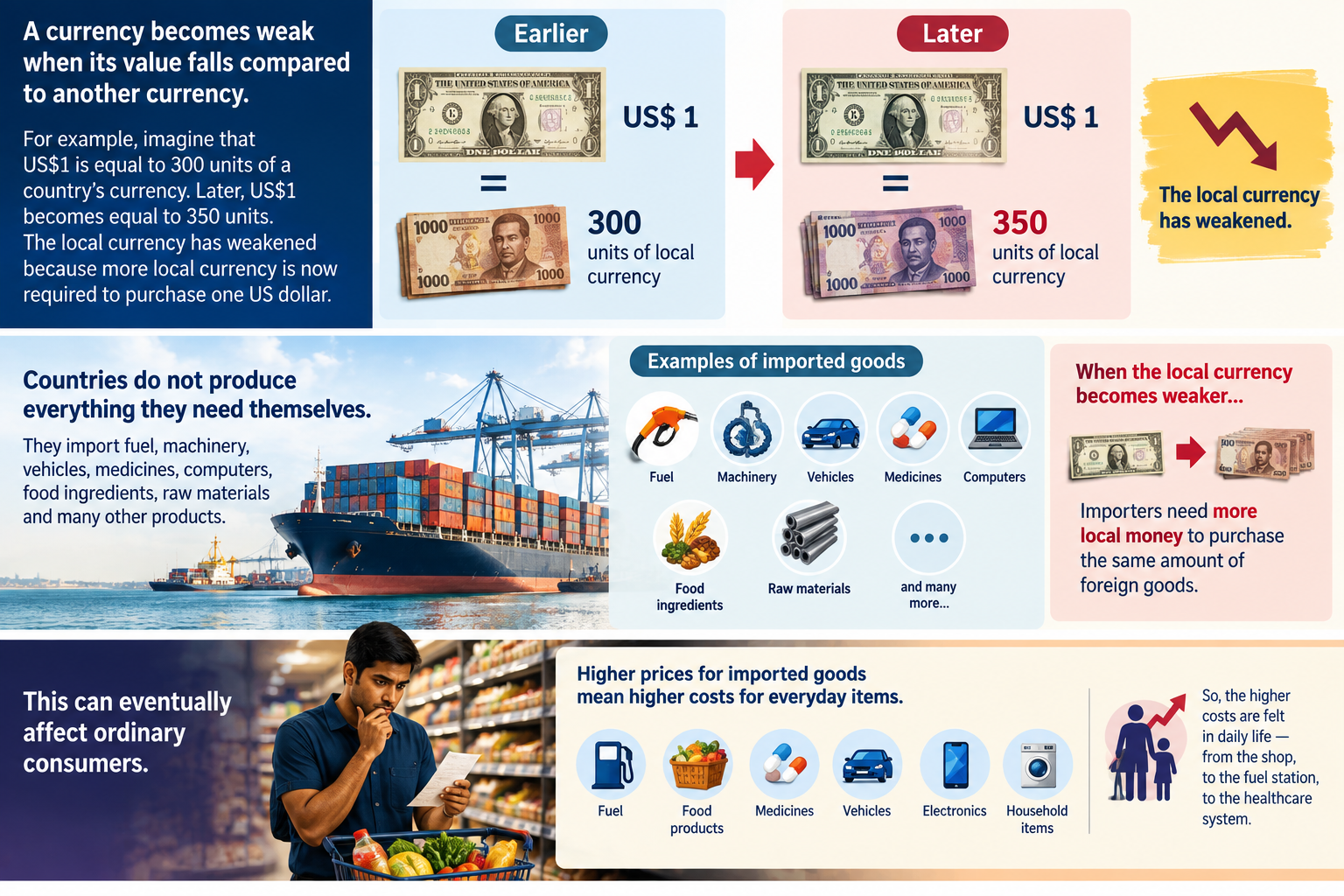
High Inflation Can Weaken a Currency
One of the biggest reasons for currency weakness is high inflation.
Inflation means that the general prices of goods and services are increasing. When inflation remains high for a long period, the purchasing power of a country's currency falls.
Imagine two countries producing similar products. If prices rise much faster in one country than in the other, its goods may become less competitive. People and businesses may also lose confidence in holding that country's currency.
High inflation can therefore create a cycle.
Prices increase, people lose purchasing power, confidence falls and demand for the currency may decline. If investors believe inflation will remain high, they may prefer to keep their money in stronger foreign currencies or other assets
A Country Imports More Than It Exports
Another important reason is a persistent trade deficit.
A country has a trade deficit when the value of its imports is greater than the value of its exports.
- For example, a country may spend billions of dollars importing fuel, vehicles, machinery, electronics, medicine and food while earning less foreign currency from exports.
Importers need foreign currency to pay overseas suppliers. If demand for dollars or another foreign currency becomes very high, pressure can build on the local currency.
This is especially important for countries that rely heavily on imports but have limited export income.
Lack of Foreign Currency
A country needs foreign currency for international payments.
Foreign currency can come from exports, tourism, foreign investment, remittances and international borrowing.
If these sources decline while import requirements remain high, a country can experience a foreign exchange shortage.
This can put significant pressure on the local currency.
- For example, if a country earns fewer dollars from tourism and exports but still needs large amounts of dollars to purchase fuel and machinery, demand for dollars may exceed supply. The result can be a weaker local currency.
Government Debt and Economic Problems
Government debt can also affect confidence in a currency.
When a government borrows heavily, investors may begin questioning whether the country can comfortably repay its debts.
If confidence falls, foreign investors may reduce investments or move money out of the country.
This can reduce demand for the local currency.
Government borrowing is not always harmful. Countries borrow money to build infrastructure, improve transportation, support businesses or finance development projects.
The problem becomes more serious when debt grows faster than the country's ability to generate income .If investors believe economic problems are becoming difficult to control, currency pressure can increase.
Political Instability
Politics can have a major effect on currency values.
Businesses and investors generally prefer countries where laws, policies, institutions and economic decisions are relatively predictable.
Political instability can create uncertainty.
Investors may delay projects, reduce investments or move their money to safer markets. Businesses may also become less willing to expand.
When foreign investment decreases, the flow of foreign currency into the country can decline.
This is one reason why political stability is not only a political issue. It is also an economic issue.
Interest Rates and Central Banks
Central banks play an important role in influencing currencies. When inflation becomes high a central bank may increase interest rates.
Higher interest rates can make financial assets in that country more attractive to investors.
However, interest rates are not a magic solution.
If investors believe that inflation, debt, political instability or other economic problems are too serious, higher interest rates may not be enough to strengthen the currency.
Central banks also manage foreign reserves, control monetary conditions and communicate economic policies. Their decisions can strongly influence market confidence.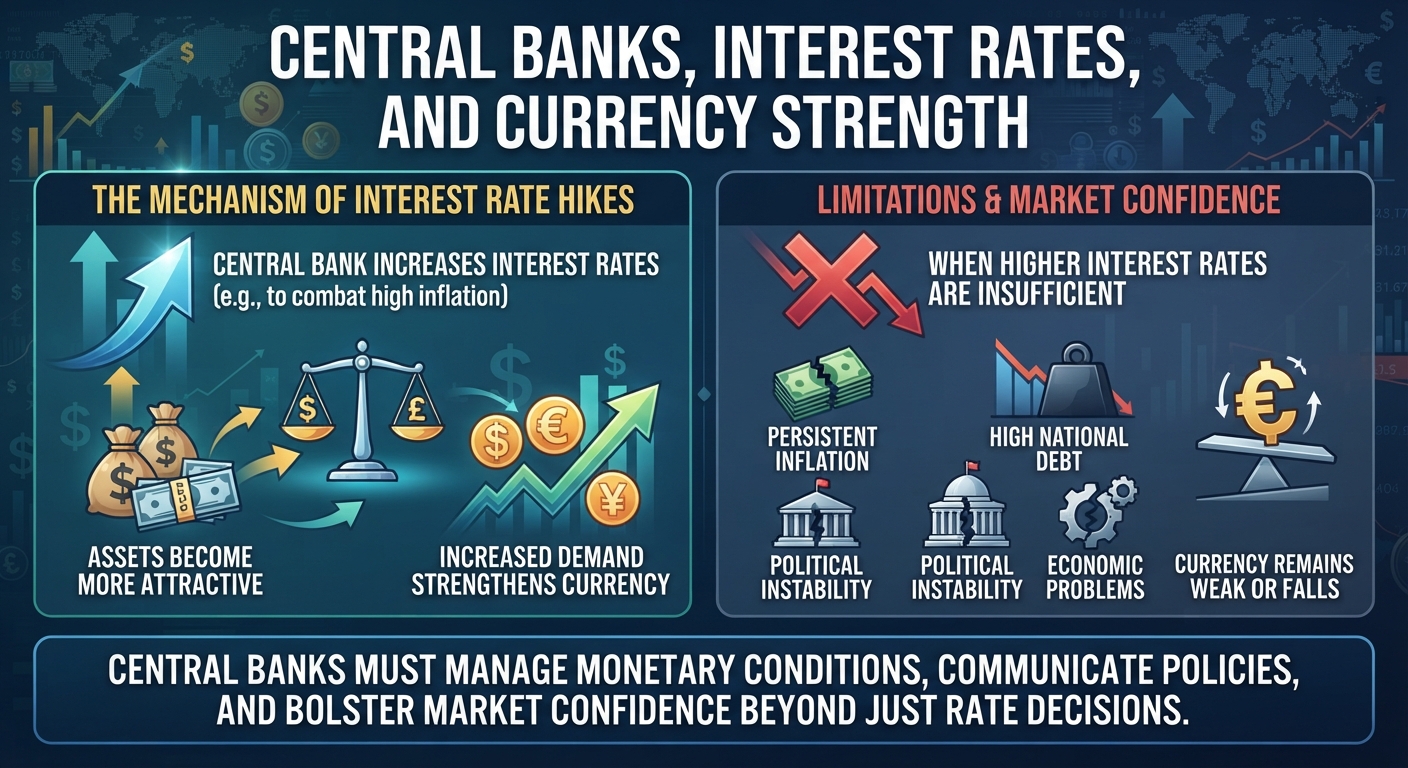
Falling Exports
Exports are an important source of foreign currency.
A country that exports tea, garments, technology, automobiles, agricultural products, minerals or other goods can earn foreign currency from international customers.
If exports fall significantly, foreign currency earnings may also decline.
There can be many reasons for falling exports. International demand may decrease, production costs may increase, global competition may become stronger, or political and economic problems may reduce production.
For an export dependent country, maintaining competitive industries is therefore important for currency stability.
How a Weak Currency Affects Ordinary People?
The most visible effect is often higher prices. If a country imports fuel, a weaker currency can increase the local cost of petrol, diesel, gas and transportation.
Higher transportation costs can then affect almost everything else because businesses use transportation to move products.
Imported food can become more expensive. Medicines and medical equipment can cost more. Smartphones, computers, vehicles, spare parts, machinery and other imported products may also become more expensive.
Even locally produced goods can become more expensive if manufacturers depend on imported raw materials. Therefore, currency weakness can eventually reach almost every part of everyday life.
My Personal Perspective
In my view, a country's currency should not be judged by its exchange rate alone.
People sometimes compare currencies and immediately conclude that a country with a lower value currency is economically weaker. I do not think that is always correct.
What matters more is why the currency has that value and what is happening to people's purchasing power.
A country can have a relatively low value currency while maintaining a productive economy, strong exports, stable institutions and improving living standards.
At the same time, a country can experience serious economic problems even if its currency appears strong on paper.
Personally, I believe the biggest warning sign is not simply a weak currency. It is when the currency keeps losing purchasing power while people's incomes fail to keep up with rising prices.
When that happens, ordinary families feel the economic crisis directly. They may spend more money on basic necessities while having less money available for education, savings, housing, travel or investment.
I also believe countries should focus on producing more valuable goods and services rather than depending too heavily on imports. Strong exports, productive industries, stable institutions, responsible government spending and sound monetary policies can create a stronger economic foundation.