Tuareg Society: Desert Warriors, Culture and Survival Story
The Tuareg are a people who have, for centuries, defied the wind and maintained their identity among the vast sand dunes of the Sahara Desert. Known worldwide as the ‘blue people’ or ‘veiled people’, this tribal group is spread across northern and western Africa and has attracted the attention of anthropologists and historians for their ancient history, complex social structure, and unique cultural characteristics. Their heritage ranges from the Tifinagh script to the Tijelmoust veil, and these camel riding people were at the forefront of Saharan trade routes. However, in the face of climate change, political conflict, and economic pressures in the modern world, their traditional way of life is facing challenges. This article explores the origins, social organization, daily life, and challenges they face in modern times, as well as efforts to preserve their culture.Origins and History of the Tuareg People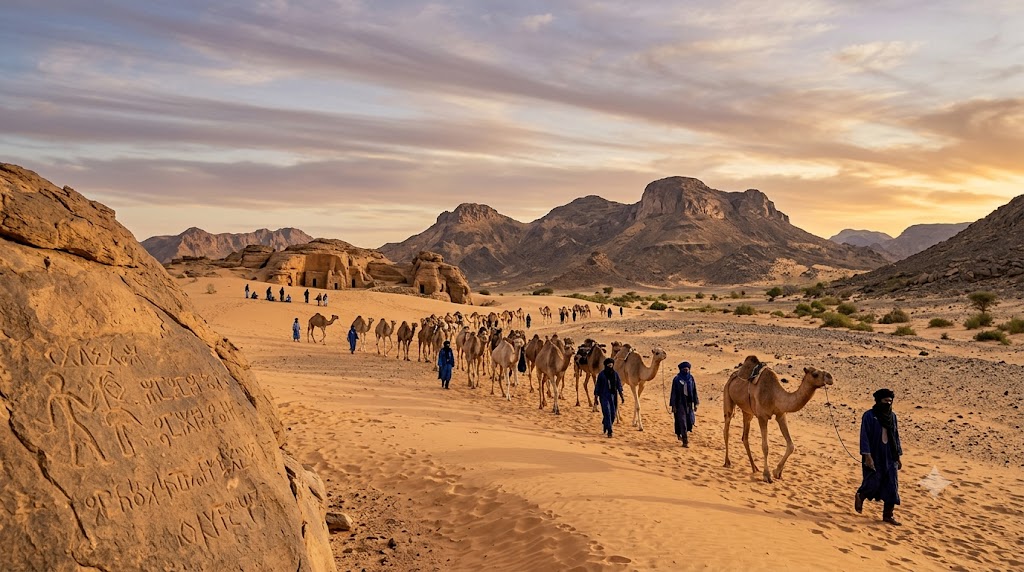
The Tuareg people, who call themselves Kel Tamasheq (Tamasheq speakers) or Imashaghen (free people), trace their history back to the Sahara Desert. The most widely accepted view of their origins is that they are descendants of the ancient Garamantes tribe who lived in the Libyan Fezzan region. Even the Greek historian Herodotus of the 5th century BC mentioned this connection. However, genetic studies reveal that their gene pool has a West Eurasian and North African composition, and some genetic lineages can be traced back 9,000 years.
A crucial turning point in the history of the Tuaregs was the introduction of the camel for trans Saharan trade in the 1st or 2nd century AD. This led to the expansion of their influence southwards. By the 14th century, there is documented evidence of trade caravans in the Ayr Mountains, and their earliest inscriptions, written in the Tifinagh script, date from this period. From the 17th century, the Tuareg were pushed further south by frequent Arab invasions of North Africa, and they gradually settled in the African Sahel region. These migrations coincide with the climatic changes of the Holocene epoch, the transition from the greening of the Sahara Desert about 10,000 years ago to aridity that began about 6,000 years ago.
Their language, Tamasheq, is a Berber language belonging to the Afro Asiatic language family. Interestingly, of all the other Berber speaking peoples, only the Tuareg have retained an ancient writing system descended from the ancient Libyan alphabet known as Tifinagh. This is a symbol of their cultural continuity and historical heritage. They became famous as the main caravan traders who transported goods across the Sahara for centuries, acting as a bridge between sub Saharan and Mediterranean cultures. Their historical journey remains a testament to their resilience in the face of cultural exchange, warfare, and natural disasters. Today, their population exceeds two million, spread across Algeria, Libya, Mali, Niger, and Burkina Faso.
Social Structure, Traditions, and Daily Life
Tuareg society has a highly complex and stratified structure. It is traditionally classified into nobles (imajaran), religious leaders (ineslemans or marabouts), subjects (imgad), artisans (inahdanen), and servants or former slaves (iklan). Each of these classes has specific roles and responsibilities. For example, the inahdanen are artisans, metalworkers, jewelry makers, and instrument makers, and are considered to have mystical and artistic knowledge in society. A distinctive feature of Tuareg society is that tribal affiliation is determined by the mother's side (matrilineal). A child's social status is determined by the mother's tribe, and after marriage, children belong to the mother's tribe, not the father's. Even in the event of tribal conflict, children are forced to fight for the mother's tribe against the father.
One of the most important symbols associated with the daily life and culture of the Tuareg is the blue veil worn by men, or tijelmust. This is a band of cloth dyed indigo blue. It is a sign of respect for men to cover their mouth, nose, and forehead in the presence of strangers, relatives, and respected elders. This custom has earned them the exotic nicknames ‘veiled men’ or ‘blue men’. Tuareg women, unlike in much of the Muslim world, do not wear a face veil, and they enjoy considerable freedom and respect in society. Their traditional home is a tent made of red animal skins, which is the home of a monogamous family. Although the Tuareg are Muslims (Islam allows up to four wives), monogamy is common among them, and a wife prefers to divorce rather than accept a second wife.
Tuareg music and art are an integral part of their worldview. Their music is believed to originate from the primordial sound of aguiv. It is a sound born from the movement of the universe, the rotation of the earth, and the environment. Using instruments such as the tende (drum), insad (comb), and tehardant (guitar), the musicians act as bridges between people, the jinn (spirits), and nature. The everyday objects created by Tuareg artisans, wooden bowls, pillows, locks, and jewelry, have deep symbolic and aesthetic value in addition to their functionality. Their silver jewelry, cross stitched designs, and colorful embroidery on leather goods illustrate their unique artistic tradition. For example, the cross stitched camel saddles made by artisans in the Air region are so famous that people come from far and wide to buy them.
Challenges and Cultural Preservation in the Modern World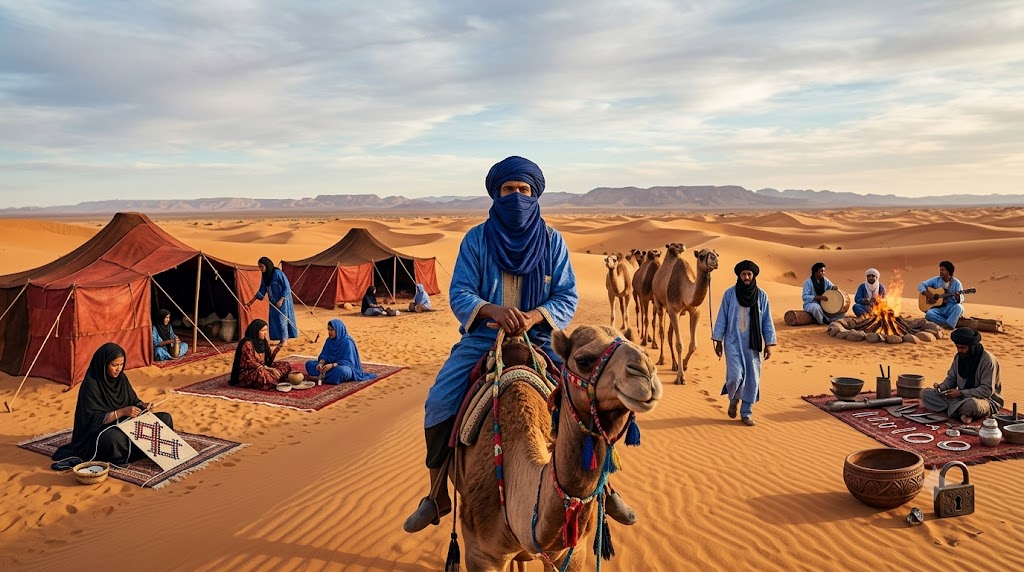
The Tuareg people face many serious challenges in the modern world. Their traditional nomadic lifestyle has been affected by climate change in the Sahara and Sahel regions. With livestock being destroyed by drought, there is little reason to follow traditional migratory routes (transhumance) in search of seasonal grazing lands. This is a major threat to their economic base and cultural identity. In addition, colonization and subsequent political conflicts have also deeply affected Tuareg society. Tuareg communities were divided as colonial powers drew new borders between North and West Africa, and this division was further deepened by national borders after independence.
In the face of these challenges, preserving Tuareg cultural identity has become of paramount importance. Their traditional worldview is expressed through rituals such as the Tahajjara, a collective procession that renews the bond between people, the nurturing earth, and the invisible world. These rituals maintain a spiritual connection with the environment. The art of Tuareg artisans and musicians continues to serve as a means of expressing their ancient knowledge and worldview. For example, the Malian filmmaker Integrist El Ansari spent 10 years creating the documentary ‘Undertows: A Tuareg Tale’ about the disappearing way of life of his people. The film shows the tragedy of the Tuareg world and the determination to keep its memory alive.
In the future, efforts are being made to adopt innovative strategies to preserve Tuareg identity. For example, the ‘Tuareg Trails of Tomorrow’ project, proposed for the city of Arlit in Niger, aims to revive the ancient Tuareg caravan routes. This is expected to revive traditional crafts such as dyeing cloth, metalworking, jewelry making, and desert farming, and create economic opportunities for young people. The project also aims to reduce environmental damage from uranium mining and increase soil fertility through sustainable agricultural practices. Such efforts demonstrate that preserving Tuareg culture is not about putting things from the past in a museum, but rather about building a sustainable future by integrating past knowledge with modern needs. The Tuareg people strive to preserve their identity through their language, the Tifinagh script, and their unique social code, and they are also keen to bring this heritage to the attention of the world.
Conclusion
The journey of the Tuareg people is like a living river flowing through different stages of history. From the Garamantes to the Saharan caravans, from colonial frontiers to modern conflicts, their journey reflects resilience, cultural flexibility, and a collective purpose rooted in identity. Their unique characteristics, such as the Tamasheq language, the Tifinagh script, and the matrilineal social structure, testify to the preservation of an identity in a globalizing world. However, the real challenge is not to place the culture in a museum, but to adapt its essence to new generations and new environments. Language revitalization among the Tuareg youth, artisanal movements, and sustainable projects such as the ‘Tuareg Trails of Tomorrow’ offer hope for the future of this heritage. Ultimately, the Tuareg people teach us that true cultural survival is not about clinging to the past, but about making its wisdom useful in the face of future challenges. Their story, like the sands of the desert, is scattered by the wind, yet every grain is filled with deep historical and cultural meaning.