Economic Indicators Everyone Should Know:A Complete Guide to Understanding the Economy
Introduction
Every day, headlines announce that inflation has increased, unemployment has fallen, or the economy has grown faster than expected. While these updates may seem like information reserved for economists and financial experts, they actually affect everyone. The price you pay for groceries, the interest on your home loan, the availability of jobs, and even the performance of your investments are all connected to the health of the economy.The challenge is that economic news often uses technical language that can make these concepts feel confusing. Terms like Gross Domestic Product (GDP), Consumer Price Index (CPI), and Purchasing Managers' Index (PMI) may sound intimidating at first, but they are simply tools used to measure different parts of an economy.Think of economic indicators as the dashboard of a car. A driver doesn't rely on just the speedometer to understand how the vehicle is performing. They also monitor the fuel gauge, engine temperature, and warning lights. In the same way, economists, businesses, governments, and investors use several indicators together to understand whether an economy is speeding ahead, slowing down, or facing potential problems.Learning these indicators doesn't require an economics degree. Once you understand what they measure and why they matter, you'll be able to interpret economic news with confidence and make smarter financial decisions in your own life.
Gross Domestic Product (GDP): Measuring the Size of an Economy
Gross Domestic Product, commonly known as GDP, is often described as the most important economic indicator. It measures the total value of all goods and services produced within a country over a specific period, usually every quarter or every year.Imagine an entire country working together to produce cars, grow crops, build homes, provide healthcare, develop software, manufacture electronics, and offer countless other services. The combined value of all this economic activity becomes the country's GDP.When GDP rises, it generally means businesses are producing more, consumers are spending more, and the economy is expanding. A growing GDP often creates more employment opportunities, higher incomes, and stronger business profits.On the other hand, if GDP begins to shrink for an extended period, it may indicate that the economy is slowing down. Businesses may reduce production, consumers might spend less, and companies could postpone investments. This is why GDP is closely watched around the world—it provides one of the clearest snapshots of a nation's economic health.However, GDP is not a perfect measure. It tells us how much an economy produces, but it doesn't explain how wealth is distributed among people or whether economic growth improves overall quality of life.
Inflation: Why Prices Keep Rising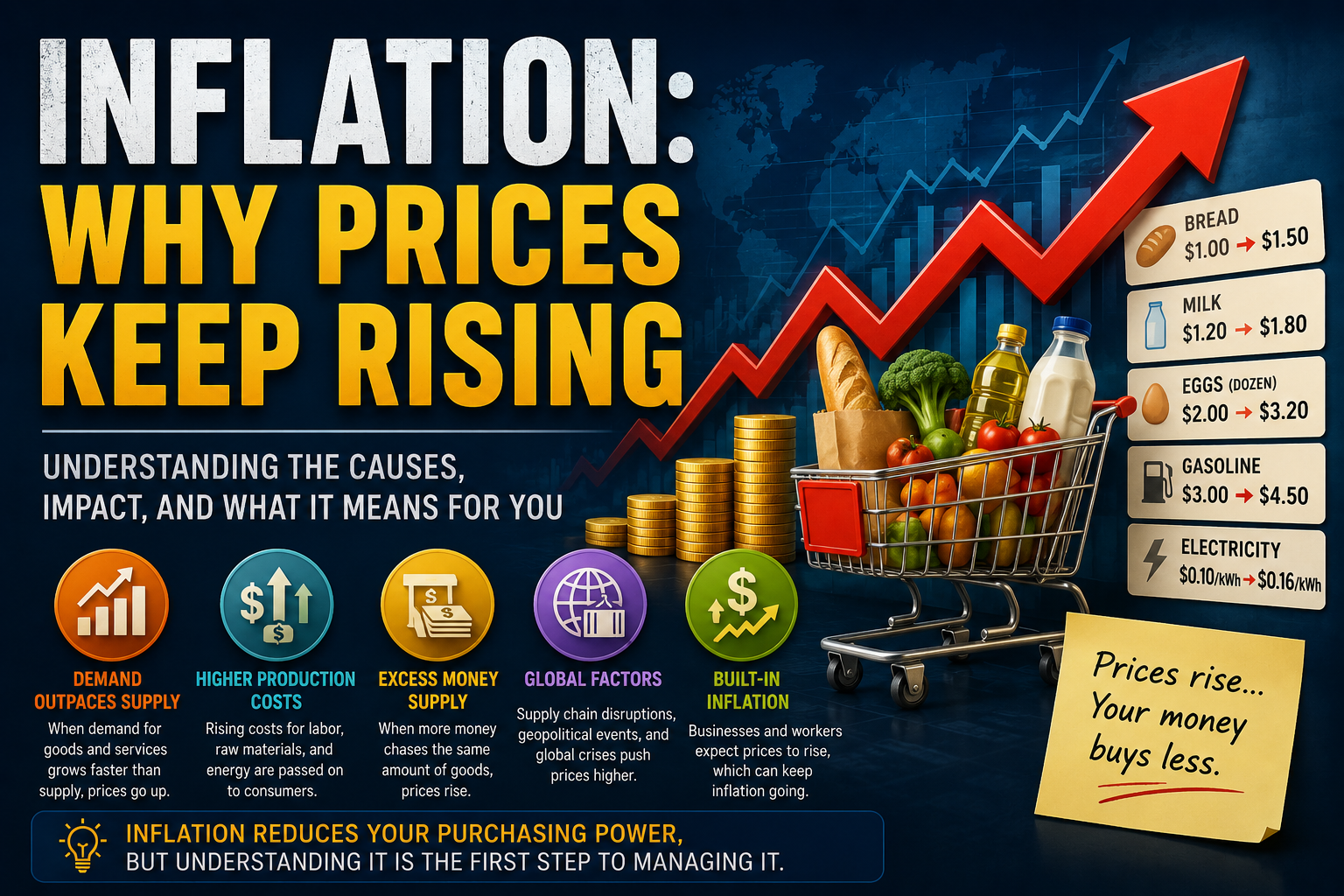
Have you ever noticed that a meal, a cup of coffee, or a movie ticket costs more today than it did a few years ago? This gradual increase in prices is called inflation.Inflation measures how quickly the average prices of goods and services rise over time. A small amount of inflation is considered healthy because it often reflects growing demand and a strong economy. Problems arise when prices increase much faster than wages, making everyday expenses more difficult to manage.High inflation reduces purchasing power, meaning your money buys fewer goods than before. Families may need to spend more on essentials like food, transportation, housing, and healthcare, leaving less money for savings or leisure activities.Inflation can occur for several reasons. Strong consumer demand, rising production costs, supply chain disruptions, or increases in the money supply can all contribute to higher prices. Because inflation affects nearly everyone, central banks monitor it carefully and adjust monetary policy to keep it under control.Understanding inflation helps explain why household budgets change over time and why governments often prioritize price stability.
The Unemployment Rate: Understanding the Job Market
Employment is one of the strongest indicators of economic well-being. The unemployment rate measures the percentage of people who are actively looking for work but cannot find a job.When unemployment is low, businesses are generally hiring, consumers have steady incomes, and spending remains strong. This creates a positive cycle where companies continue to expand and invest.When unemployment rises significantly, it often signals economic weakness. Businesses may reduce hiring, cut production, or lay off workers because demand has declined.However, unemployment is more complex than a single percentage. Some people are temporarily between jobs, while others may need to retrain because industries have changed or technology has replaced certain roles. Seasonal jobs, such as tourism and agriculture, can also influence unemployment figures during different times of the year.Looking beyond the headline number provides a more complete understanding of labor market conditions.
Interest Rates: The Cost of Borrowing Money
Interest rates influence nearly every financial decision people make. Whether you're applying for a mortgage, financing a car, starting a business, or saving money in a bank account, interest rates determine how much borrowing costs or how much your savings can earn.Central banks adjust interest rates to help balance economic growth and inflation. When inflation rises too quickly, central banks often increase interest rates to make borrowing more expensive. This encourages people and businesses to spend less, helping reduce inflationary pressure.When the economy slows, central banks may lower interest rates to encourage borrowing, investment, and consumer spending. Lower borrowing costs can stimulate business expansion and create new jobs.Because interest rates affect everything from home prices to stock markets, they remain one of the most influential economic indicators in the world.
Consumer Price Index (CPI): Tracking Everyday Living Costs
The Consumer Price Index, or CPI, measures changes in the prices consumers pay for a wide range of everyday goods and services. Instead of focusing on a single product, CPI follows a carefully selected basket that represents typical household spending.This basket includes food, housing, transportation, healthcare, education, clothing, entertainment, and other essential expenses. By comparing prices over time, economists can determine how the overall cost of living changes.Governments often use CPI to calculate inflation, adjust social benefits, and make important policy decisions. Businesses also rely on CPI when reviewing salaries, contracts, and long-term financial planning.For consumers, CPI offers a practical way to understand why monthly expenses may increase even if purchasing habits remain the same.
Producer Price Index (PPI): A Look Behind the Scenes
Before products appear on store shelves, manufacturers purchase raw materials, pay workers, and transport goods through supply chains. The Producer Price Index measures how these production costs change over time.When producers experience rising costs, they often pass those increases on to retailers and eventually consumers. As a result, changes in the Producer Price Index can provide early clues about future inflation.Economists frequently compare PPI with CPI to understand how rising business costs may affect household prices in the coming months.
Consumer Confidence: The Psychology of Spending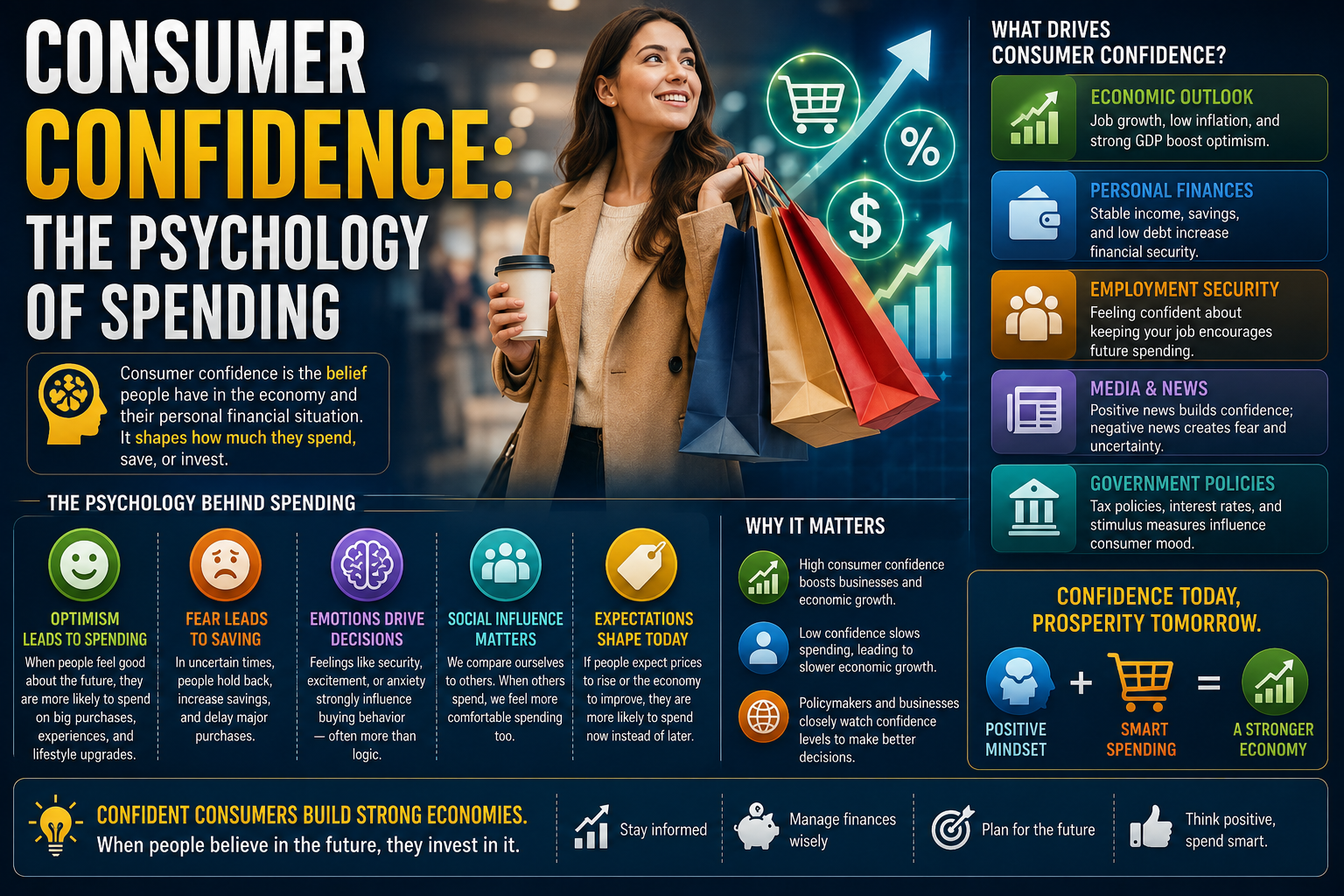
Economic performance isn't driven only by numbers—it is also influenced by human emotions. Consumer confidence measures how optimistic people feel about their personal finances and the overall economy.When consumers feel secure about their jobs and incomes, they are more willing to buy homes, purchase vehicles, travel, dine out, and invest in large purchases. Strong consumer confidence supports business growth and creates more economic activity.When confidence declines, households often become cautious. They postpone expensive purchases, increase savings, and reduce discretionary spending. This shift can slow economic growth even before official statistics begin to change.Consumer confidence demonstrates that expectations about the future can shape economic outcomes just as much as current conditions.
Retail Sales: Following Consumer Spending
Consumer spending represents one of the largest drivers of economic growth. Retail sales measure how much people spend at stores, restaurants, online retailers, and other businesses.Strong retail sales suggest households have confidence in their financial situation and continue to spend regularly. Weak retail sales may indicate growing economic uncertainty or declining purchasing power.Retail activity often reflects seasonal trends, particularly during holidays and major shopping events, making it an important indicator for businesses planning inventory and production.The Housing Market: More Than Just Real EstateHousing is much more than buying and selling homes. A healthy housing market creates demand for construction workers, architects, furniture manufacturers, banks, insurance companies, and home improvement businesses.Economists monitor home prices, new construction, building permits, and home sales to evaluate housing activity.A growing housing market usually reflects consumer confidence and economic stability, while declining home sales may signal higher borrowing costs or weaker demand.Because housing affects so many industries, it often provides valuable insights into the broader economy.
Industrial Production: Measuring Business Activity
Factories, mines, and utility companies form the backbone of industrial production. This indicator measures how much these sectors produce over time.Rising industrial production generally signals stronger demand from consumers and businesses. Companies may hire additional workers, purchase new equipment, and expand operations.Declining production, however, may indicate slowing demand, reduced investment, or economic uncertainty.Industrial production helps economists identify changes in business activity before they become visible in broader economic statistics.Trade Balance: Understanding International Commerce. Modern economies rely heavily on international trade. Countries buy products from abroad while exporting goods and services to global markets.The trade balance compares the value of exports with imports. When exports exceed imports, a country records a trade surplus. When imports exceed exports, it experiences a trade deficit.Neither outcome is automatically positive or negative. The significance depends on factors such as domestic demand, investment, exchange rates, and economic growth.Trade data provides valuable insights into a country's competitiveness in the global economy.
Purchasing Managers' Index (PMI): An Early Warning Signal
The Purchasing Managers' Index offers one of the earliest glimpses into changing business conditions. It is based on surveys completed by managers responsible for purchasing materials and managing production.Because these professionals often notice changes in customer demand before official statistics are released, PMI serves as a leading economic indicator.A reading above 50 generally suggests business expansion, while a reading below 50 points toward contraction.Investors and economists pay close attention to PMI because it frequently signals economic turning points before other indicators.
Why No Single Indicator Tells the Whole Story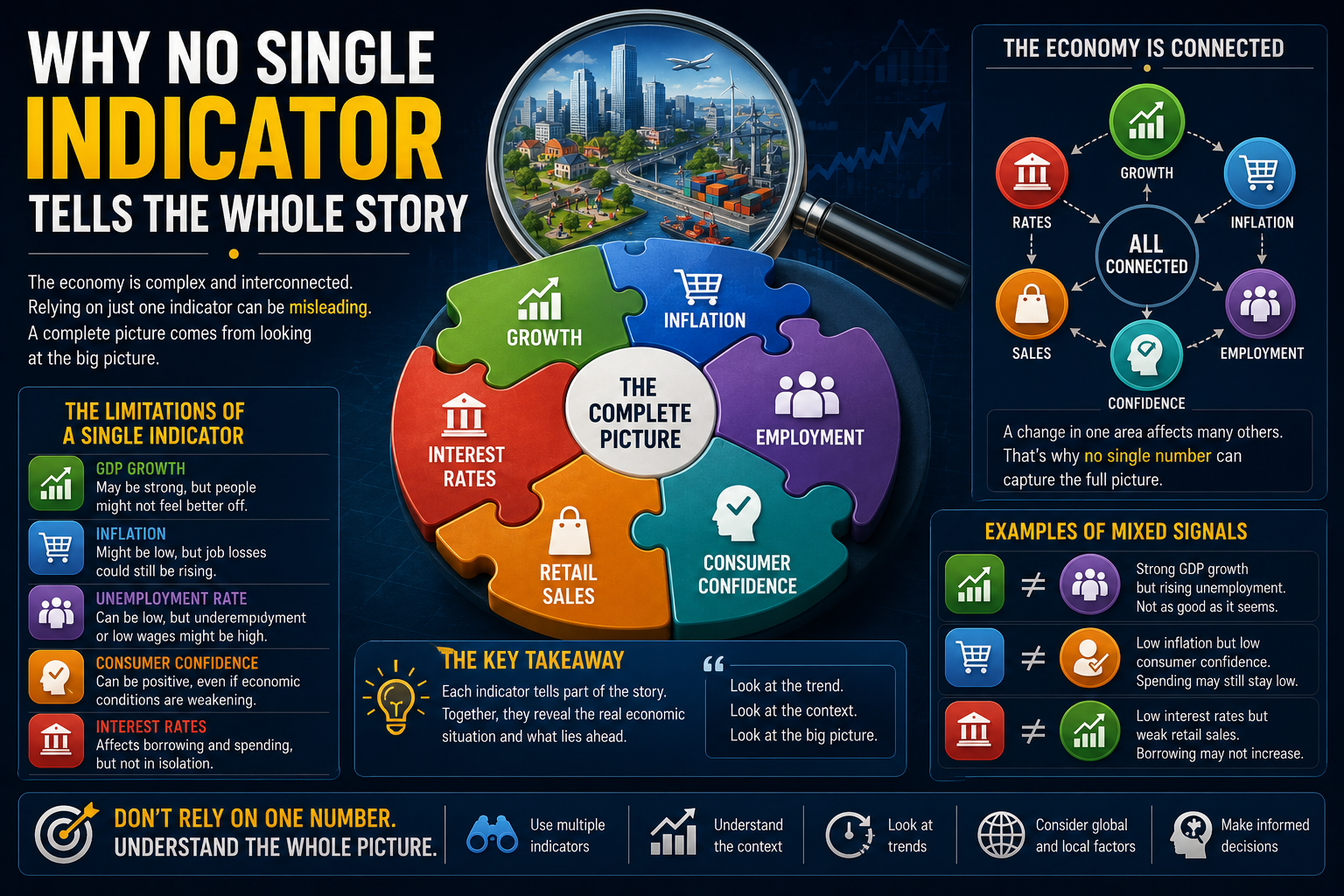
Although each economic indicator provides valuable information, none offers a complete picture on its own. An economy is a complex system where different factors influence one another.For example, GDP may continue growing while inflation rises sharply. Employment could remain strong even as consumer confidence begins to weaken. Interest rates might increase to control inflation, slowing housing activity while manufacturing continues to expand.This is why economists analyze multiple indicators together rather than relying on a single statistic. Looking at the complete picture allows governments, businesses, and investors to make more informed decisions.
Conclusion
Economic indicators are far more than numbers published in financial reports. They tell the story of how people earn, spend, save, invest, and build their futures. From GDP and inflation to unemployment, consumer confidence, and housing activity, each indicator reveals a different piece of the economic puzzle.Understanding these measurements helps you interpret news headlines, make better financial decisions, evaluate investment opportunities, and recognize the forces shaping your daily life. While economists may use sophisticated models to analyze data, the basic principles behind these indicators are accessible to everyone.The more familiar you become with economic indicators, the easier