Asian Countries and Their Major Exports
Different Asian countries have developed different export strengths.
China is a major exporter of electronics, machinery, textiles, and manufactured products. Japan is well known for automobiles, machinery, electronics, and advanced technology. South Korea exports automobiles, electronics, ships, and technology products.
India has a strong service export sector, especially information technology, software, pharmaceuticals, textiles, and agricultural products. Bangladesh is famous for garment exports. Vietnam has developed strong exports in electronics, textiles, footwear, and agricultural products.
Thailand exports automobiles, electronics, agricultural products, and food products. Malaysia exports electronics, petroleum related products, palm oil, and other manufactured goods.
Sri Lanka exports tea, garments, rubber products, spices, coconut products, and services.
These examples show that Asian countries can use their natural resources, labour, skills, technology, and geographical advantages to participate in international trade.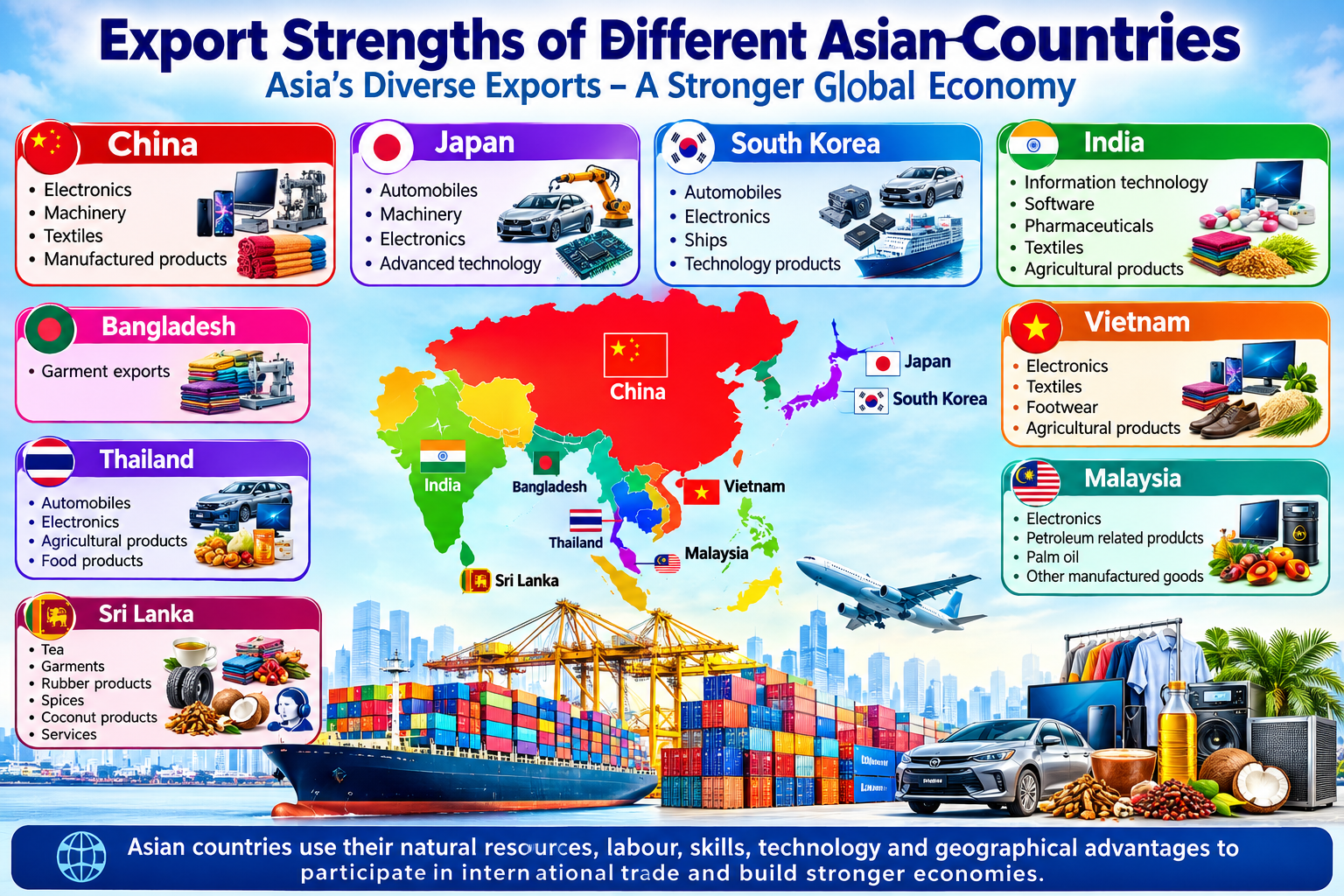
1. Exports Bring Foreign Currency
One of the biggest benefits of exports is that they bring foreign currency into a country. When a company sells products to another country, it receives payment in an international currency such as US dollars, euros or Japanese yen. Foreign currency is very important for Asian countries because they need to buy many products from other countries. For example, a country may need to import fuel, medicines, machinery, vehicles, computers, and raw materials. Export earnings help a country pay for these imports. If a country earns more foreign currency through exports, it can have a stronger ability to meet its international payments. For example, Sri Lanka exports tea, garments, rubber products, spices, and services. The foreign currency earned from these exports can be used to pay for important imports.
2. Exports Create Employment
Exports create many employment opportunities. When demand for a country's products increases in foreign markets, companies need to produce more goods. To increase production, businesses need more workers. For example, the garment industry in Bangladesh and Vietnam provides employment to a large number of people. Similarly, India's information technology industry provides employment to many skilled workers. Exports also create indirect employment. A company that exports tea needs workers for tea production, packaging, transportation, storage, quality control, and shipping. Therefore, one export industry can create jobs in many other sectors. This helps reduce unemployment and provides people with regular incomes.
3. Exports Increase Production
International demand encourages companies to increase their production. When businesses receive more orders from foreign customers, they need to produce more goods and services. For example, if a Vietnamese company receives a large international order for electronic products, it may increase its production capacity. It may purchase new machines, employ more workers, and increase the amount of raw materials it purchases. Higher production increases economic activity. Suppliers, transport companies, warehouses, banks, insurance companies, and other businesses also benefit. Therefore, exports can create a chain of economic activities throughout the country.
4. Exports Support Economic Growth
Exports contribute directly to a country's Gross Domestic Product, or GDP. GDP is the total value of goods and services produced in a country. When a country exports more goods and services, its total economic activity can increase. Businesses earn more income, workers receive salaries, suppliers receive payments, and the government can collect more taxes. Many successful Asian economies have used exports as an important part of their development strategy. China, Japan, South Korea, Singapore, and Vietnam are good examples of countries that have developed strong export industries. Export led growth can help developing countries move from low income economic activities toward higher value industries.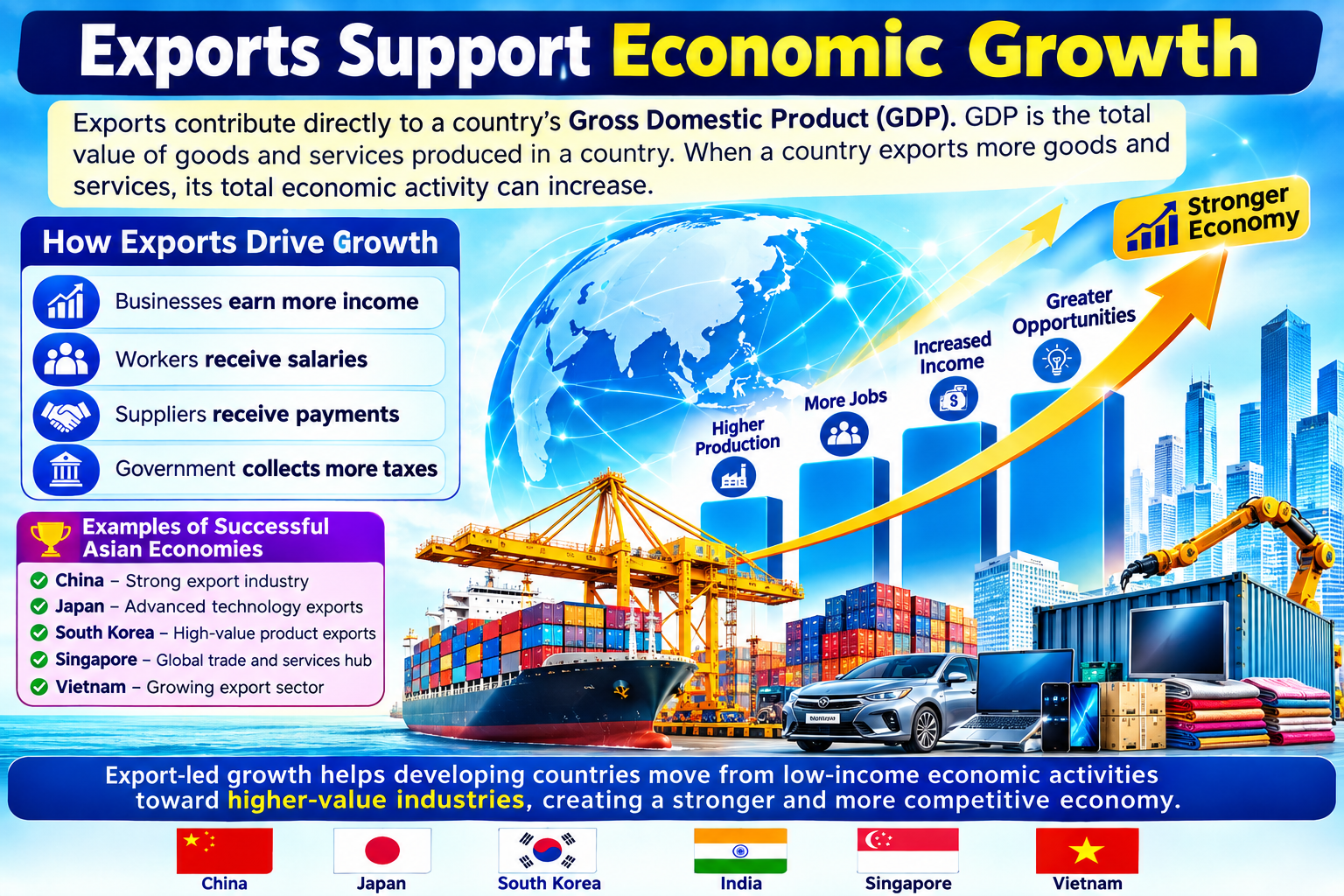
5. Exports Encourage Industrial Development
Exports encourage the development of industries. When businesses want to compete in international markets, they need to improve their production systems and product quality. For example, Asian countries have developed industries such as electronics, automobiles, textiles, information technology, pharmaceuticals, machinery, food processing, and chemicals. South Korea is well known for industries such as automobiles, electronics, and technology. Japan has developed strong automobile, machinery, and technology industries. China has become a major producer of electronics, machinery, and manufactured products. The growth of export industries can also encourage the development of supporting industries within the country.
6. Exports Encourage Better Quality
International customers usually expect good quality products. Therefore, companies that want to export must maintain international quality standards. This encourages businesses to improve their products, packaging, production methods, customer service, and quality control systems. For example, a Sri Lankan tea company selling tea to international customers must maintain good quality because customers can choose products from many different countries. Competition in international markets encourages companies to become more efficient and provide better products. As a result, export activities can improve the overall quality of goods and services produced in a country.
7. Exports Encourage Technology and Innovation
Exporting companies often need modern technology to compete with international businesses. They may invest in advanced machines, computer systems, automation, research, and modern production techniques.
For example, Asian countries such as Japan, South Korea, China, and Singapore have invested heavily in technology and innovation to strengthen their export industries.
Technology can increase productivity, reduce production costs, improve quality, and save time.
Therefore, exports can encourage companies to move from traditional production methods to modern and efficient methods.
8. Exports Attract Foreign Investment
Strong export industries can attract foreign investors. Foreign companies may invest in a country because they see opportunities to produce goods and sell them in international markets. For example, a foreign company may establish a factory in Vietnam because the country has strong manufacturing industries and access to international markets. Foreign investment can bring capital, technology, management knowledge, training, and new business opportunities. This can further increase production, employment, and economic growth.
9. Exports Increase Government Revenue
Export related business activities can contribute to government revenue through taxes, business registrations, income taxes, and other charges. When export companies grow, their employees earn higher incomes and businesses purchase more goods and services. These activities can increase the government's tax base. The government can use its revenue to develop roads, ports, schools, hospitals, electricity systems, transport facilities, and other public services. Therefore, a successful export sector can indirectly support national development.
10. Exports Help Reduce Poverty
Exports can help reduce poverty by creating employment and increasing household incomes.
For example, agricultural exports can provide income for farmers, while garment exports can provide employment for factory workers. Technology and service exports can provide opportunities for educated and skilled workers.
When people earn stable incomes, they can spend more on food, education, housing, healthcare, and other necessities.
Therefore, export growth can improve the living conditions of many people, especially in developing Asian countries.
11. Exports Improve the Balance of Trade
Exports are also important for maintaining a healthy balance of trade. The balance of trade is the difference between the value of exports and imports.
If a country imports much more than it exports for a long period, it may face pressure on its foreign currency reserves.
Increasing exports can help reduce this pressure by bringing more foreign currency into the country.
For Asian developing countries, increasing exports can therefore be an important way to strengthen external economic stability.
12. Exports Develop Infrastructure
Export activities require good infrastructure. Countries need roads, ports, airports, warehouses, communication systems, electricity, and transportation facilities to move products efficiently.
When exports increase, governments and businesses may invest more in infrastructure.
For example, large ports and modern transportation systems are very important for countries such as China, Singapore, South Korea, and Vietnam because they handle large volumes of international trade.
Better infrastructure also benefits local businesses and ordinary people.
Exports play a major role in the economic development of Asian countries. They bring foreign currency, create employment, increase production, support industries, attract foreign investment, encourage technology, improve product quality, and increase economic growth. Countries such as China, Japan, South Korea, India, Vietnam, Bangladesh, Thailand, Malaysia, and Sri Lanka show how exports can contribute to national development. However, countries should manage export growth carefully and avoid depending too much on one product or one international market. They should invest in education, technology, infrastructure, innovation, and high value industries. In conclusion, exports can be considered an important engine of economic growth. A strong and diversified export sector can help Asian countries create jobs, increase national income, reduce poverty, improve living standards, and become more competitive in the global economy.