How Central Banks Control a Country's Entire Economy?
When we think about who controls the economy of a country, we may first think about the government, businesses, banks or consumers. However, there is another institution that has a very powerful influence, the Central Bank.
A Central Bank does not literally control every part of the economy. It cannot tell every person what to buy or every company what to produce. However, it can influence the conditions under which people, businesses and financial institutions make economic decisions.
Through interest rates, money supply, inflation management, exchange rates, banking regulations, and financial policies, a central bank can influence almost every major part of an economy.
Through interest rates, money supply, inflation management, exchange rates, banking regulations, and financial policies, a central bank can influence almost every major part of an economy.
- In simple words, when the central bank changes the cost and availability of money, the behavior of the whole economy can change.
What Is a Central Bank?
A central bank is the main monetary authority of a country.
For example, the Central Bank is responsible for monetary policy and important functions related to financial and monetary stability in a country.
One of the main responsibilities of a central bank is maintaining price stability. This means trying to keep inflation under control.
It also plays an important role in maintaining financial stability and supporting a healthy banking system.
This is important because modern economies depend heavily on banks and credit. People borrow money to buy houses and vehicles. Businesses borrow money to expand. Companies use loans to purchase machinery and maintain operations.
Therefore, when the central bank changes monetary conditions, the effects can spread throughout the economy.
Interest Rates Are One Of Its Most Powerful Tools
One of the most important ways a central bank influences the economy is through interest rates.
Imagine that interest rates are reduced.
When borrowing becomes cheaper, people may become more willing to take loans. Businesses may also borrow money to invest in new equipment, open new branches, employ more workers or increase production.
Consumers may also borrow more money to purchase houses, vehicles or other expensive items.
This can increase economic activity. On the other hand, when inflation becomes too high a central bank may increase interest rates.
Higher interest rates make borrowing more expensive. People may reduce their spending, while businesses may postpone investments.
This can reduce demand in the economy and help slow down inflation.
I think this is one of the clearest examples of how a decision made by a central bank can eventually reach an ordinary person.
A person may never speak to the central bank, but if loan interest rates increase, their monthly loan payment can increase. If rates fall, their borrowing costs may decrease.
Controlling Inflation
Inflation means a general increase in the prices of goods and services over time.
A small and stable level of inflation can exist in a growing economy. However, very high inflation can create serious problems.
When prices rise quickly, people's purchasing power falls. The same amount of money buys fewer goods and services.
For example, if a family earns the same salary while food, transport, electricity and other costs continue increasing, the family may have to reduce spending on other things.
Central banks therefore pay close attention to inflation.
One way of controlling high inflation is increasing interest rates. This can reduce borrowing and spending, which can reduce demand for goods and services.
However, controlling inflation is not always simple. Prices can rise because of factors such as fuel prices, food shortages, exchange rate movements, supply problems or international events.
Therefore, a central bank cannot simply solve every inflation problem by changing interest rates.
Managing the Money Supply
Another important responsibility of a central bank is influencing the amount of money and liquidity available in the financial system.
If money and credit are easily available, people and businesses may spend and invest more.
If monetary conditions become tighter, borrowing and spending may slow down.
This creates a connection between monetary policy and economic activity.
Too much monetary expansion for too long can contribute to inflationary pressure. On the other hand, very tight monetary conditions can reduce economic activity.
The central bank therefore has to find a balance.
In my opinion, this is one of the most difficult responsibilities of a central bank because economic conditions are constantly changing.
A decision that is appropriate today may not be appropriate several months later.
Influencing the Exchange Rate
Central bank policies can also affect the value of a country's currency.
Exchange rates are extremely important for countries that depend on imports and exports. If a country's currency loses value against major foreign currencies, imported goods can become more expensive.
For example, if a country imports fuel, machinery, medicine, vehicles or raw materials, a weaker currency can increase the local cost of those products.
Exporters may benefit from a weaker currency because their products can become more competitive in international markets. However, businesses that depend heavily on imported materials may face higher costs.
This shows that exchange rate movements can affect both businesses and consumers.
Central banks may also use foreign exchange reserves and other measures as part of managing external and monetary stability, depending on the country's framework.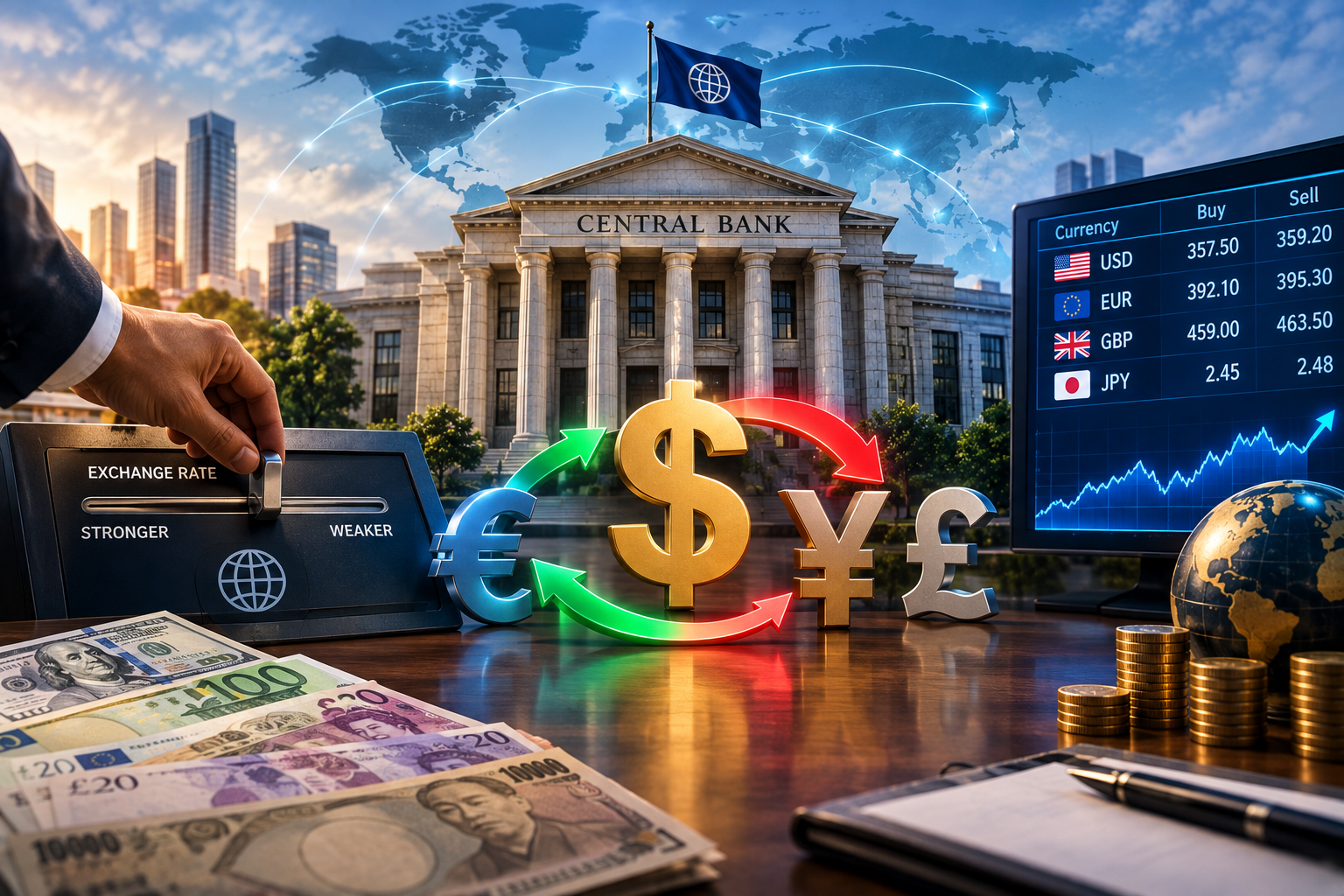
Supporting the Banking System
Central banks are also closely connected to the banking system.
Commercial banks are extremely important because they hold deposits and provide loans to individuals and businesses.
If confidence in the banking system falls, people may rush to withdraw their money. This can create serious financial problems.
Central banks can provide emergency liquidity to financial institutions under appropriate conditions when the financial system faces severe stress.
They also play important roles in banking supervision or work closely with relevant regulatory authorities, depending on the country's institutional structure.
This is important because problems in one major financial institution can sometimes spread to other parts of the financial system.
Supporting Economic Growth
Central banks also have an important relationship with economic growth.
When an economy is weak, monetary conditions may sometimes be eased to encourage borrowing, spending and investment.
This can support economic activity.
However, central banks have to consider inflation and financial stability at the same time.
If monetary policy remains too loose for too long, it can contribute to excessive borrowing, asset price increases or inflationary pressure.
This means a central bank cannot simply keep interest rates very low forever to create growth.
It has to consider the wider economy.
My Personal Perspective
Personally, I think the power of a central bank becomes clearer when we stop looking only at economic charts and start looking at ordinary people's lives.
A central bank announcement may appear to be just a number or an interest rate decision on the news.
But behind that decision are millions of people.
There may be a young person trying to buy their first vehicle.
There may be a family paying a housing loan.
There may be a small business owner trying to expand a shop.
There may be a student trying to find a job in an economy where businesses are reducing investment.
There may also be someone trying to protect their savings from inflation.
All of these people can be affected by monetary policy.
In my view, this is why central banking is such an important part of the economy. The decisions are not only about banks and financial markets. They can eventually affect salaries, jobs, loan payments, savings, prices, business investments and the general cost of living.
At the same time, I believe people should understand that central banks cannot solve every economic problem.
If a country has weak infrastructure, low productivity, poor education, inefficient government systems or problems with production, changing interest rates alone cannot solve those issues.
A healthy economy needs cooperation between monetary policy, government policy, businesses, workers and consumers.